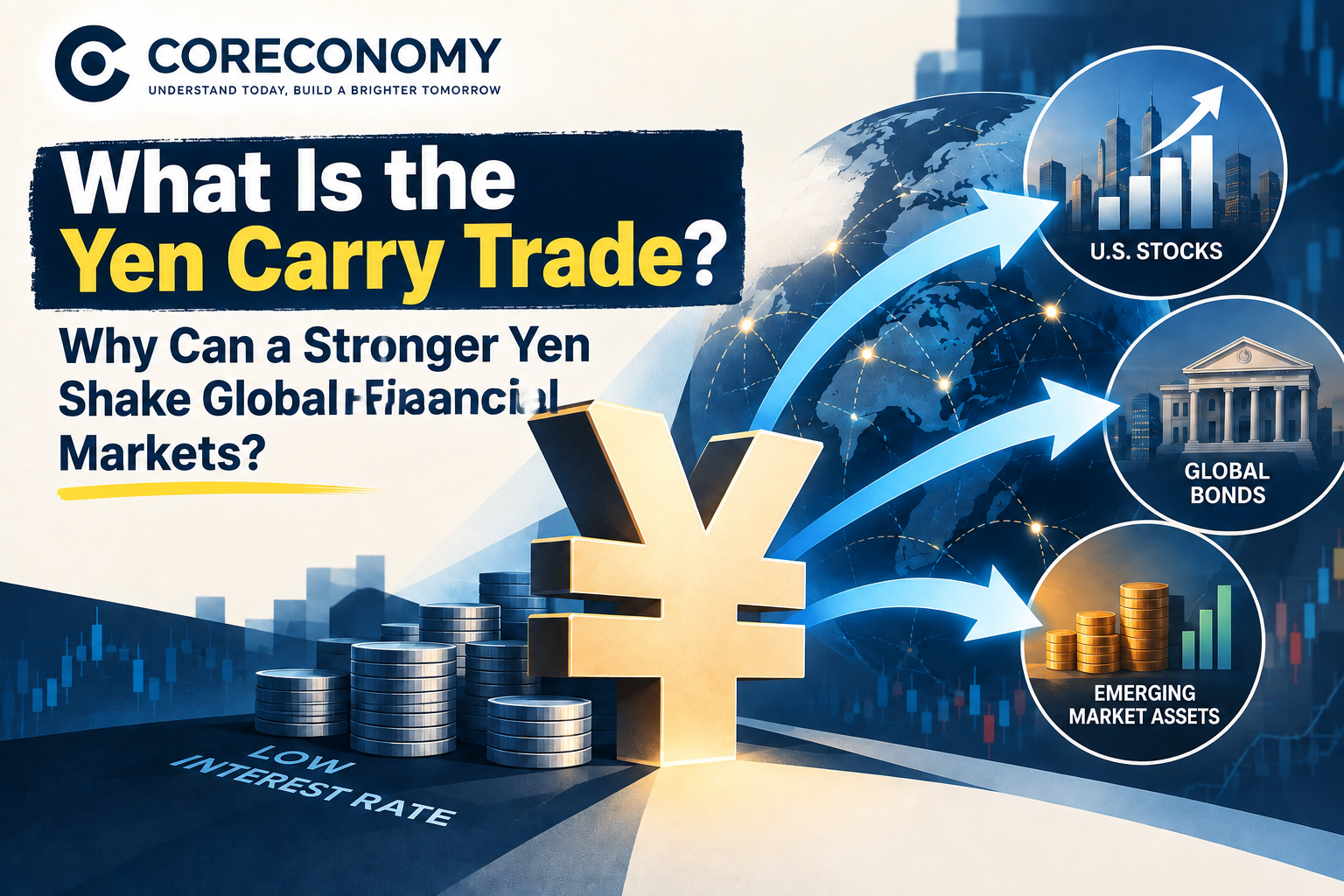
The yen carry trade is a strategy in which investors borrow Japanese yen at relatively low interest rates, convert the money into another currency, and invest it in overseas assets that are expected to offer higher returns.
At first glance, this may look like a simple investment strategy. But the yen carry trade has played an important role in global financial markets because the yen has long been one of the world’s major funding currencies.
For years, investors could borrow yen at relatively low costs and use the money to invest in U.S. stocks, bonds, emerging-market assets, and other investments around the world.
The problem is that this strategy depends on certain conditions remaining favorable.
If Japanese interest rates rise or the yen strengthens significantly, the profitability of the trade can deteriorate. Investors may then reduce or unwind their positions. When many investors do this at the same time, the process can create buying pressure for the yen and selling pressure across the overseas assets that had been purchased with yen-funded money.
That is why the yen carry trade is not simply a story about the Japanese economy.
The key point is that the yen has been used as a funding currency for global investment, so changes in yen funding conditions can spill over into financial markets around the world.
1. What Is the Yen Carry Trade?
A carry trade is a strategy in which investors borrow in a currency with a relatively low funding cost and invest the money in assets or currencies that are expected to provide higher returns.
In a yen carry trade, the Japanese yen is the funding currency.
For example, suppose an investor borrows yen in Japan.
The investor can then exchange those yen for U.S. dollars and invest the dollars in U.S. stocks or bonds.
The expected return from this strategy comes from two main sources.
The first is the difference between the funding cost and the investment return.
If it costs less to borrow yen than the return available on the overseas investment, the difference can provide a source of profit.
The second is the exchange rate.
Eventually, the investor has to convert the proceeds from the overseas investment back into yen and repay the yen borrowing. That means the movement of the yen during the investment period also matters.
So the key idea behind a yen carry trade is not simply that “Japanese interest rates are low.”
It is the combination of borrowing yen at a relatively low cost, investing the money in overseas assets with higher expected returns, and benefiting from the difference in returns without suffering a large adverse currency move.
2. Why Has the Yen Been Such an Important Funding Currency?
The yen became a major funding currency largely because Japan maintained very low interest rates for an extended period.
Japan spent many years dealing with weak inflation and sluggish economic growth, and monetary policy remained exceptionally accommodative for a long time.
At the same time, interest rates in the United States and other major economies were often much higher.
This difference became especially important after 2022, when the Federal Reserve raised U.S. interest rates rapidly to fight inflation.
From an investor’s perspective, borrowing yen at a relatively low cost and converting it into dollars or another currency became more attractive when the return available overseas was substantially higher.
As these transactions accumulated, the yen became more than a currency used for transactions within Japan.
It became an important funding currency for global investors.
That is why understanding the yen carry trade requires looking beyond Japan itself.
The important question is also where the yen-funded money is ultimately invested.
3. Where Does the Return From a Yen Carry Trade Come From?
Consider a simplified example.
Suppose an investor can borrow yen at an annual interest rate of 1%.
The investor converts the money into U.S. dollars and invests it in an asset expected to earn 5%.
In a simplified calculation, the investor could expect roughly a 4-percentage-point difference between the funding cost and the investment return.
Of course, real-world carry trades are more complicated. Investors have to consider transaction costs, taxes, hedging costs, asset-price movements, and other risks.
But the basic principle remains the same.
The larger the difference between the funding cost and the expected investment return, the more attractive the carry trade can become.
That makes the interest-rate difference between Japan and other economies one of the most important variables to watch.
If U.S. interest rates are high while Japanese rates remain low, borrowing yen to invest in dollar-denominated assets can become more attractive.
If Japanese rates rise or U.S. rates fall, however, the difference becomes smaller.
The incentive to maintain an existing yen carry trade can then weaken.
4. Why Can Higher Japanese Interest Rates Disrupt the Yen Carry Trade?
It is not enough to say simply that “the interest-rate differential becomes smaller.”
Higher Japanese interest rates can also increase the actual funding cost for investors who have borrowed yen.
Suppose an investor has borrowed ¥100 million.
At an annual interest rate of 1%, the interest expense is ¥1 million per year.
If the interest rate rises to 2%, the annual interest expense becomes ¥2 million.
If the return from the overseas investment remains unchanged, the profit from the interest-rate difference becomes smaller.
The effect can be particularly important when the borrowing is floating-rate or when the position needs to be refinanced.
Leverage can make the impact even larger.
If an investor is not using ¥100 million of their own money but instead has borrowed ¥1 billion to build a larger position, even a relatively small increase in funding costs can have a meaningful effect on the profitability of the trade.
So higher Japanese interest rates do more than make new yen carry trades less attractive.
They can also increase the cost of maintaining existing positions and encourage investors to reduce or unwind them.
5. Why Does a Stronger Yen Also Hurt the Yen Carry Trade?
Interest rates are only part of the story.
The exchange rate is equally important.
An investor borrows yen, converts it into another currency, and invests in overseas assets.
Eventually, the investor needs to convert the proceeds back into yen and repay the original borrowing.
Now suppose the yen becomes significantly stronger during that period.
Imagine that the exchange rate is ¥150 per U.S. dollar when the investor converts yen into dollars.
Later, the yen strengthens and the exchange rate moves to ¥130 per dollar.
The same amount of dollars will now convert into fewer yen.
Because the investor’s borrowing is denominated in yen, the stronger yen makes the repayment more expensive relative to the value of the foreign-currency investment.
Even if the overseas investment generated a profit, the stronger yen can reduce or even eliminate that profit when the money is converted back into yen.
For this reason, a yen carry trade generally benefits from three conditions:
1. Low yen funding costs
2. Attractive returns on the overseas investment
3. A yen that does not appreciate sharply
A major change in any one of these conditions can reduce the profitability of the trade.
6. What Happens When a Yen Carry Trade Is Unwound?
An unwind means reducing or closing an existing carry-trade position.
The basic process is fairly straightforward.
Suppose an investor borrowed yen, converted it into U.S. dollars, and used the dollars to buy U.S. stocks.
To unwind the position, the investor first sells the U.S. stocks.
The dollars are then converted back into yen, and the yen borrowing is repaid.
The basic flow is:
Sell overseas assets → sell the foreign currency → buy yen → repay the yen borrowing
This is an important point.
An unwind is not simply a matter of “bringing yen back to Japan.”
The overseas assets that were purchased with yen-funded money may also have to be sold.
That means a large-scale unwind can create buying pressure for the yen at the same time that it creates selling pressure in the overseas financial assets that had been financed by the trade.
7. How Can a Yen Carry Trade Unwind Affect Global Financial Markets?
This is what makes the yen carry trade important beyond Japan.
Yen-funded money does not necessarily stay in Japan. It can flow into U.S. stocks, bonds, emerging-market assets, and many other financial markets around the world.
If a large number of carry trades are unwound, several things can happen at the same time.
First, the yen can strengthen.
Investors selling overseas assets need to convert the proceeds back into yen to repay their yen borrowing.
That increases demand for the yen and can create additional upward pressure on the currency.
Second, overseas risk assets can come under selling pressure.
If yen-funded money was invested in U.S. stocks or emerging-market assets, investors may need to sell those assets when reducing their positions.
The selling pressure can therefore spread across multiple financial markets rather than remaining inside Japan.
Third, leverage can amplify the move.
When a leveraged position starts generating losses, an investor may need to reduce the position or provide additional collateral.
In some cases, positions may have to be reduced not because the investor voluntarily wants to sell, but because risk limits or margin requirements force the position to be reduced.
This can create a chain reaction:
Asset selling → larger losses → further position reductions → more asset selling
That is one reason a relatively small change in interest rates or exchange rates can sometimes produce a much larger move in financial markets.
8. August 2024 Showed How This Mechanism Can Work
The yen carry trade attracted significant attention during the global market turmoil in early August 2024.
There was not a single cause.
First, weaker-than-expected U.S. labor-market data increased concerns about a slowdown in the U.S. economy.
At the same time, the Bank of Japan raised its policy rate at the end of July, increasing the possibility that the interest-rate gap between Japan and the United States would narrow.
The combination helped push the yen higher and reduced the profitability of positions that had borrowed yen to invest in overseas assets.
As some leveraged positions were unwound, buying pressure for the yen and selling pressure on risk assets emerged at the same time. The IMF has described the episode as an example of how a narrowing U.S.-Japan interest-rate differential and a stronger yen contributed to the unwinding of leveraged yen carry trades and amplified market volatility.
But it would be wrong to say that the global market sell-off was caused by the yen carry trade alone.
Concerns about a slowing U.S. economy had already triggered risk aversion. The Bank of Japan’s policy shift and the stronger yen then helped accelerate the unwinding of carry positions.
In other words, the yen carry trade was not the sole cause of the market shock.
It acted as an additional transmission and amplification channel that increased selling pressure once the initial shock was already underway.
That is the important lesson from the 2024 episode.
9. Why Does Yen Carry Trade Risk Increase When the Yen Strengthens?
Consider the situation from the perspective of a carry-trade investor.
Japanese interest rates rise.
→ The cost of borrowing yen increases.
At the same time, U.S. interest rates fall.
→ The return advantage of dollar assets becomes smaller.
Then the yen strengthens.
→ The investor faces a larger currency loss when converting the overseas investment back into yen.
Finally, market volatility rises.
→ Leveraged positions become harder to maintain.
When these conditions occur together, the incentive to maintain a yen carry trade can deteriorate rapidly.
This is why looking at Japanese interest rates alone is not enough.
To understand the risk of a yen carry trade unwind, it is useful to watch Japanese interest rates, overseas interest rates, the yen exchange rate, and financial-market volatility together.
10. How Can a Yen Carry Trade Unwind Become a Chain Reaction?
A carry-trade unwind does not necessarily happen as a single, isolated transaction.
Consider the following sequence.
Japanese interest rates rise.
→ Yen funding costs increase.
U.S. interest rates fall.
→ The U.S.-Japan interest-rate differential narrows.
The yen strengthens.
→ Currency losses on existing yen carry positions increase.
Investors reduce their positions.
→ They sell overseas assets and buy yen.
The yen strengthens further.
→ The currency losses of investors who are still holding carry positions become larger.
Leveraged investors hit their risk limits or face margin pressure.
→ Additional positions are forced to reduce or close.
If this process continues, a relatively small change in interest rates and exchange rates can turn into a much larger move in financial markets.
Of course, not every investor has the same position, and some investors hedge their currency exposure.
So this chain reaction does not automatically happen every time the yen strengthens.
But the possibility matters because leverage can turn relatively small changes in funding costs or exchange rates into much larger position adjustments.
11. Does This Mean a Large Yen Carry Trade Unwind Is Happening Now?
Not necessarily.
The total size of global yen carry-trade positions is difficult to measure precisely.
Not every transaction involving borrowed yen is a carry trade, and some investors hedge their foreign-exchange exposure.
Therefore, it would be too simplistic to say:
“The yen is strengthening, so a massive yen carry trade unwind must be happening.”
What matters is that the environment surrounding the yen carry trade has changed compared with the era of extremely low Japanese interest rates.
The Bank of Japan has been moving away from its previous ultra-low-rate environment. As of September 24, 2026, the Bank of Japan’s policy guidance calls for the uncollateralized overnight call rate to remain around 1.25%.
The important question now is not simply whether Japanese interest rates are higher than they used to be.
The more important questions are how much further Japanese rates may rise, how interest rates in the United States and other economies may move, and how the yen responds to those changes.
12. What Should You Watch in 2026?
There are four variables worth watching when assessing the risk surrounding the yen carry trade.
① Japanese interest rates
If the Bank of Japan raises rates further, the cost of yen funding can increase.
This can be particularly important for positions that use floating-rate funding or need to be refinanced.
② The U.S.-Japan interest-rate differential
If U.S. interest rates fall relative to Japanese rates, or Japanese rates rise relative to U.S. rates, the gap between U.S. and Japanese rates becomes smaller.
A narrower differential can reduce the incentive to borrow yen and invest in dollar-denominated assets.
③ The yen exchange rate
A rapid appreciation of the yen can increase currency losses on existing yen carry positions.
For leveraged positions, even a relatively small exchange-rate move can have a significant impact on profitability.
④ Financial-market volatility
When volatility rises, investors tend to become less willing or able to maintain leveraged risk positions.
So if interest rates and exchange rates determine the profitability of a carry trade, volatility can influence how quickly those positions may be reduced or unwound.
13. Why Does the Yen Carry Trade Matter to the Global Economy?
The yen carry trade should not be understood simply as a Japanese investment strategy.
The more important point is that the yen has long served as an important funding currency in global financial markets.
Money borrowed in yen can flow into U.S. stocks and bonds, emerging-market assets, and many other investments.
During stable periods, this can be one channel through which capital moves across global financial markets.
But when market conditions change sharply, the flow can reverse.
Investors may sell overseas assets and buy yen to repay their borrowing.
That creates the possibility of:
Yen appreciation + overseas asset selling
at the same time.
When leverage is high, the initial move can also trigger additional position reductions by other investors, increasing market volatility.
This is why the yen carry trade can be viewed as one of the channels connecting Japanese monetary policy to global financial markets.
14. The Most Important Point to Remember
You do not need to understand every complex financial instrument to understand the yen carry trade.
The basic chain is enough.
Japanese interest rates rise
→ Yen funding costs increase
→ The profitability of the carry trade declines
→ Existing positions become more likely to be reduced
If the yen also strengthens, the problem becomes more serious.
Investors selling overseas assets need to buy yen to repay their borrowing, while the stronger yen creates additional currency losses on positions that remain open.
That can further encourage investors to close their positions.
So a particularly difficult environment for the yen carry trade is one in which:
Japanese rates rise + overseas rates fall + the yen strengthens + financial-market volatility increases.
When these conditions occur together, the incentive to maintain existing yen carry positions can fall sharply, while the unwind can create simultaneous buying pressure for the yen and selling pressure across overseas risk assets.
Conclusion
The yen carry trade is more than a strategy of “borrowing cheaply in Japan and investing overseas.”
The more important point is that the money borrowed in yen can move through financial markets around the world.
During favorable conditions, relatively low yen funding costs can create an attractive source of return for investors.
But when Japanese interest rates rise, overseas interest rates fall, or the yen strengthens, the economics of the trade can change.
Funding costs rise, the interest-rate advantage becomes smaller, and currency losses can emerge.
When investors reduce their positions, they may have to sell overseas assets and buy yen to repay their borrowing.
If many leveraged positions are involved, those moves can trigger additional position reductions and increase financial-market volatility.
The market turmoil of August 2024 provided a real-world example of this mechanism. The episode cannot be explained by the yen carry trade alone, but the combination of yen appreciation, narrowing interest-rate differentials, and leveraged position unwinding showed how the yen can act as a transmission channel for global market stress.
Japan is now moving further away from the ultra-low-rate environment that supported the yen carry trade for many years. That does not mean that a large-scale unwind is inevitable.
What matters going forward is how Japanese interest rates, overseas interest rates, the yen exchange rate, and financial-market volatility move together.
The key to understanding the yen carry trade is not simply knowing that investors can borrow yen cheaply.
It is understanding what happens to global financial markets when the assumption that cheap yen funding will remain available begins to break down.