If you follow economic news, you have probably heard the term GDP many times.
“GDP growth slowed.”
“GDP declined, raising concerns about the economy.”
“GDP per capita increased.”
But what exactly does GDP measure, and why is it so important when people talk about the economy?
GDP is one of the most widely used economic indicators for measuring the value of goods and services produced within an economy over a given period of time.
However, it is not quite accurate to think of GDP simply as “how much money a country makes.” GDP is not the same thing as national income, personal wealth, or the total value of everything a country owns.
In this article, we will look at what GDP means, how it is calculated, the difference between nominal and real GDP, how to interpret GDP growth, and why GDP alone cannot tell us everything about an economy.
1. What Is GDP?
GDP stands for Gross Domestic Product.
The three words describe the concept:
- Gross: total
- Domestic: within a country’s borders
- Product: production
In simple terms, GDP is the total value of final goods and services produced within a country’s borders during a specific period of time.
There are several important parts to this definition.
Produced domestically
The word “domestic” refers to where production takes place, rather than the nationality of the company or producer.
For example, suppose a U.S. company operates a factory in South Korea and produces cars there.
That production takes place in South Korea, so it contributes to South Korea’s GDP.
On the other hand, if a South Korean company operates a factory in another country and produces goods there, that production contributes to the GDP of the country where the factory is located.
This is why it is important to distinguish between what is produced within a country and what is produced by a country’s citizens or companies.
Produced over a period of time
GDP measures economic activity over a specific period, such as a quarter or a year.
It is therefore different from the value of assets that exist at a particular point in time.
For example, the market value of all the homes in a country is not GDP.
GDP measures newly produced goods and services during a given period.
Final goods and services
GDP generally measures the value of final goods and services.
Why not simply add up every product at every stage of production?
Because that could result in double counting.
Imagine a loaf of bread.
A farmer produces wheat. A mill turns the wheat into flour. A bakery uses the flour to make bread and sells the finished loaf to a customer.
If we added the value of the wheat, flour, and bread together, part of the same economic activity would be counted more than once.
GDP therefore focuses on the value of the final product, or otherwise accounts for value added at each stage, to avoid double counting.
2. How Is GDP Calculated?
One of the most common ways to understand GDP is through the expenditure approach.
The basic formula is:
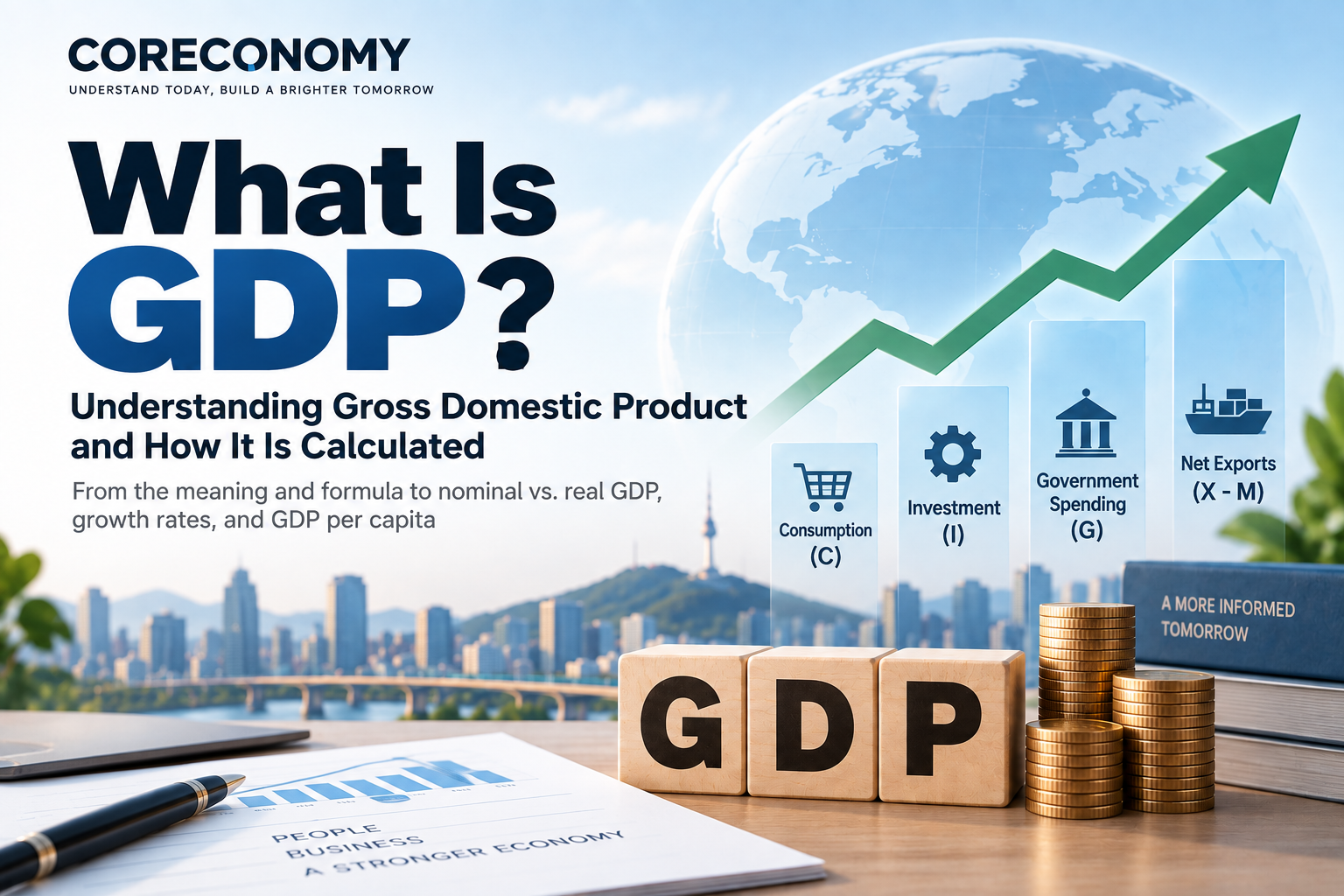
GDP = C + I + G + (X – M)
The components are:
- C (Consumption): household consumption
- I (Investment): investment in productive assets and inventories
- G (Government Spending): government purchases of goods and services
- X (Exports): exports
- M (Imports): imports
In other words:
GDP = Consumption + Investment + Government Spending + Net Exports
Let’s look at each component.
3. What Does Consumption (C) Mean?
Consumption refers to household spending on goods and services.
Examples include:
- Food and groceries
- Restaurant meals
- Clothing
- Cars
- Healthcare services
- Education services
- Travel and accommodation
Many of the things households purchase in everyday life become part of economic activity.
Consumption is therefore an important component of GDP.
When households increase their spending, businesses may see higher sales and increase production.
On the other hand, if households become more uncertain about the economy or experience a decline in income, they may reduce spending. This can affect business sales, production, and investment.
However, an increase in spending does not necessarily mean that the economy has become healthier in every respect.
For example, if prices rise significantly, people may spend more money without actually purchasing more goods and services.
This is why it is important to distinguish between changes in prices and changes in the amount of goods and services produced.
4. Does Investment (I) Mean Buying Stocks?
Not necessarily.
The word investment has a specific meaning in GDP accounting.
It generally refers to spending on productive assets and inventories that can support future economic activity.
For example, a business may:
- Build a new factory
- Purchase machinery and equipment
- Expand production facilities
- Increase its inventories
These activities can increase or maintain the economy’s capacity to produce goods and services.
So when you see “investment” in the GDP formula, do not automatically think of buying stocks or bonds.
GDP investment is primarily about spending related to productive capacity and inventories, rather than financial investments such as purchasing shares.
5. What Does Government Spending (G) Mean?
Government spending in the GDP formula refers to government purchases of goods and services.
For example, when a government pays for the construction of a road or purchases services needed to provide public services, that activity can contribute to GDP.
However, not every payment made by a government is counted as government spending in GDP in the same way.
GDP measures the value of goods and services produced during the period.
For example, a government transfer payment to an individual and a government purchase of construction services are treated differently in GDP accounting.
6. Why Are Exports Added and Imports Subtracted?
The GDP formula adds exports and subtracts imports.
Understanding why makes the formula much easier to remember.
Exports are goods and services produced domestically and purchased by people or businesses abroad.
Because they were produced domestically, they are part of domestic production and therefore contribute to GDP.
Imports are different.
Suppose a consumer in the United States buys a car manufactured in another country.
The purchase may initially appear as household consumption, but the car itself was not produced domestically.
The value of that imported production therefore needs to be removed.
This is why GDP includes net exports, or:
Exports – Imports
In other words, an increase in exports tends to increase GDP, while an increase in imports tends to reduce GDP, all else being equal.
But this does not mean that imports are necessarily bad for an economy.
Imports can give consumers access to a wider range of products and provide businesses with raw materials, components, and equipment.
Imports are subtracted from GDP because GDP is intended to measure domestic production, not because importing goods is inherently harmful.
7. What Is the Difference Between Nominal GDP and Real GDP?
One of the most important concepts to understand when learning about GDP is the difference between nominal GDP and real GDP.
Why do we need two different measures?
Because prices change.
Imagine that a country produces 100 apples.
Last year, each apple sold for $1, so the total value of production was $100.
This year, the country still produces exactly 100 apples, but the price rises to $1.20 per apple.
The total value of production is now $120.
GDP has increased from $100 to $120.
But the country did not produce any more apples.
The increase came entirely from higher prices.
This is why we need to distinguish between an increase in the value of production and an increase in the amount of production.
Nominal GDP
Nominal GDP measures the value of goods and services using current prices.
Because it uses current prices, nominal GDP reflects both changes in production and changes in prices.
Real GDP
Real GDP adjusts for changes in prices so that we can better understand changes in the actual volume of economic production.
Put simply:
Nominal GDP is useful for looking at the value of economic output at current prices, while real GDP is more useful for understanding how much actual production has changed after removing the effect of price changes.
8. When Should You Look at Nominal GDP vs. Real GDP?
Neither measure is always more important than the other.
The right measure depends on what you want to know.
If you want to know whether the economy actually grew
Look at real GDP.
If prices rise while production stays the same, nominal GDP can increase even though the economy is not producing more goods and services.
Real GDP removes the effect of price changes and therefore provides a better way to examine changes in actual economic activity.
This is why real GDP plays an important role when economists discuss economic growth rates.
If you want to compare the size of economies at current prices
Nominal GDP is useful.
For example, when comparing the current dollar value of different economies, nominal GDP is commonly used.
If prices have risen significantly and you want to know whether production actually increased
Look at real GDP.
Suppose prices rise by 10% while actual production barely changes.
Nominal GDP could increase substantially.
But it would be misleading to say that the economy “grew by 10%” simply because nominal GDP increased by that amount.
Real GDP helps separate the effect of higher prices from changes in actual production.
A simple guide
| What do you want to know? | What should you look at? |
|---|---|
| How much did the economy actually grow? | Real GDP |
| What is the economic growth rate? | Real GDP growth |
| What is the economy worth at current prices? | Nominal GDP |
| Did GDP rise because of higher prices? | Compare nominal and real GDP |
| How large are economies at current prices? | Nominal GDP is commonly used |
So nominal and real GDP are not competing measures where one is always better.
They answer different questions and are often most useful when considered together.
9. What Does GDP Growth Mean?
You will often hear about “GDP growth” in economic news.
GDP growth measures how economic output has changed compared with an earlier period.
For example, if real GDP increases compared with the previous year, the economy has experienced real economic growth.
If real GDP declines, measured economic activity has decreased.
Suppose a country’s real GDP is:
- Last year: 1,000
- This year: 1,030
The growth rate is approximately 3%.
But when reading a GDP growth figure, you should always check what it is being compared with.
An annual growth rate, a quarter-over-quarter growth rate, and a year-over-year growth rate can tell you different things.
Quarterly GDP can also be affected by seasonal factors, so it is important not to draw broad conclusions about the entire economy from a single quarterly figure.
10. Does Higher GDP Mean People Are Better Off?
Not necessarily.
An increase in GDP basically means that the value of measured economic production has increased.
It does not mean that everyone’s standard of living has improved by the same amount.
For example, GDP may increase while much of the additional economic activity is concentrated in certain industries or among certain groups.
Population growth also matters.
A country can have a larger total GDP while its GDP per capita increases only slightly, or even declines.
That is why it can be useful to look at GDP alongside other measures such as GDP per capita, income distribution, employment, inflation, and productivity.
11. What Is GDP Per Capita?
GDP per capita is simply GDP divided by the population.
GDP per capita = GDP ÷ Population
For example, if a country’s GDP is $1 trillion and its population is 50 million, dividing GDP by the population gives GDP per capita.
GDP per capita can provide more context than total GDP because it gives an indication of the amount of economic output per person.
But it is still an average.
An average does not tell us how income or economic resources are distributed among individuals.
Therefore, a high GDP per capita does not mean that every person in the country has a high income or the same standard of living.
12. Why Can’t GDP Tell Us Everything About an Economy?
GDP is an extremely useful economic indicator, but it does not provide a complete picture of an economy.
There are several important limitations.
Income distribution
GDP can increase without the benefits of that additional production being distributed evenly across society.
GDP measures the overall scale of economic production, but it does not directly tell us who receives how much of the resulting income.
Household work and other non-market activities
Many activities performed outside markets have economic and social value but are not directly recorded in GDP.
For example, unpaid household work and caring for family members can be important activities even though they are not generally recorded like market transactions.
The environment and quality of life
GDP can increase even when economic activity creates environmental costs such as pollution or resource depletion.
GDP also does not directly measure factors such as leisure time, life satisfaction, or the quality of social relationships.
The quality of economic activity
GDP measures the value of goods and services produced.
It does not, by itself, tell us whether those goods and services have improved people’s lives or whether the production process has created other costs.
For this reason, GDP should not be treated as a single score that captures everything about an economy.
13. How Is GDP Related to a Recession?
GDP is an important indicator for understanding the direction of economic activity.
In particular, a decline in real GDP can provide important information about weakening economic activity.
However, it is too simplistic to say that “two consecutive quarters of declining GDP automatically means a recession.”
A recession involves a broader decline in economic activity, and GDP is only one part of the picture.
Economists and institutions may also consider indicators such as employment, consumer spending, investment, and industrial production when assessing economic conditions.
GDP is therefore an important clue when understanding a recession, but it does not explain the entire concept by itself.
14. What Should You Check When You See a GDP Figure?
When you encounter a GDP figure in the news, do not look only at whether the number went up or down.
Ask a few additional questions.
First, is it nominal GDP or real GDP?
You need to know whether the change reflects higher prices, higher production, or both.
Second, what is the growth rate being compared with?
A year-over-year rate and a quarter-over-quarter rate can tell you different things.
Third, which part of GDP changed?
Was the change driven by consumption, business investment, government spending, exports, or imports?
Looking at the components can help explain what is happening beneath the headline GDP number.
Fourth, does population growth matter?
Total GDP and GDP per capita provide different information.
Fifth, do other economic indicators tell a similar story?
Looking at employment, consumption, investment, industrial production, and inflation alongside GDP can give you a more complete picture of economic conditions.
15. Are There Other Economic Indicators Similar to GDP?
There are several economic concepts that may look or sound similar to GDP.
For example, you may come across GNI (Gross National Income), GNP (Gross National Product), NNP (Net National Product), and PPP (Purchasing Power Parity).
These concepts do not measure exactly the same thing as GDP.
Some focus more on who receives the income rather than where production takes place. Others take factors such as depreciation or differences in price levels between countries into account.
Looking at these measures alongside GDP can therefore provide additional perspectives on a country’s economy, national income, and living standards.
However, each concept has its own purpose and the differences between them are easier to understand when examined separately.
16. GDP in One Sentence
GDP is the total value of final goods and services produced within a country’s borders over a given period of time.
From the expenditure perspective:
GDP = Consumption + Investment + Government Spending + Net Exports
When interpreting GDP, one of the most important distinctions is between nominal GDP and real GDP.
Nominal GDP includes the effects of price changes, while real GDP adjusts for those changes to provide a clearer picture of changes in actual economic production.
So, as a basic rule:
If you want to know whether the economy actually grew, look at real GDP. If you want to understand the size of an economy at current prices, nominal GDP is generally the relevant measure.
GDP is extremely useful for understanding the size and growth of an economy.
But a rising GDP does not automatically mean that everyone is better off. GDP alone cannot fully describe income distribution, quality of life, or environmental conditions.
GDP is therefore a starting point for understanding an economy, not a complete answer about how an economy is doing.
When you read economic news, look beyond the headline GDP number. Consider real GDP, the basis of the growth rate, the components of GDP, and other indicators such as employment and consumer spending.
That will give you a much clearer understanding of what is happening in the economy.
Key Takeaways
- GDP measures the value of final goods and services produced within a country’s borders over a specific period.
- From the expenditure perspective, GDP can be expressed as Consumption + Investment + Government Spending + Net Exports.
- Nominal GDP uses current prices, while real GDP adjusts for price changes to help measure changes in actual production.
- Real GDP is particularly important when measuring economic growth.
- Nominal GDP is commonly used when comparing the size of economies at current prices.
- GDP per capita is GDP divided by population and provides different information from total GDP.
- GDP is useful for understanding economic size and growth, but it does not capture everything about income distribution, quality of life, or the environment.
- GDP should therefore be considered alongside other economic indicators rather than treated as a complete measure of economic well-being.
- Concepts such as GNI, GNP, NNP, and PPP measure different aspects of an economy and are worth understanding separately.