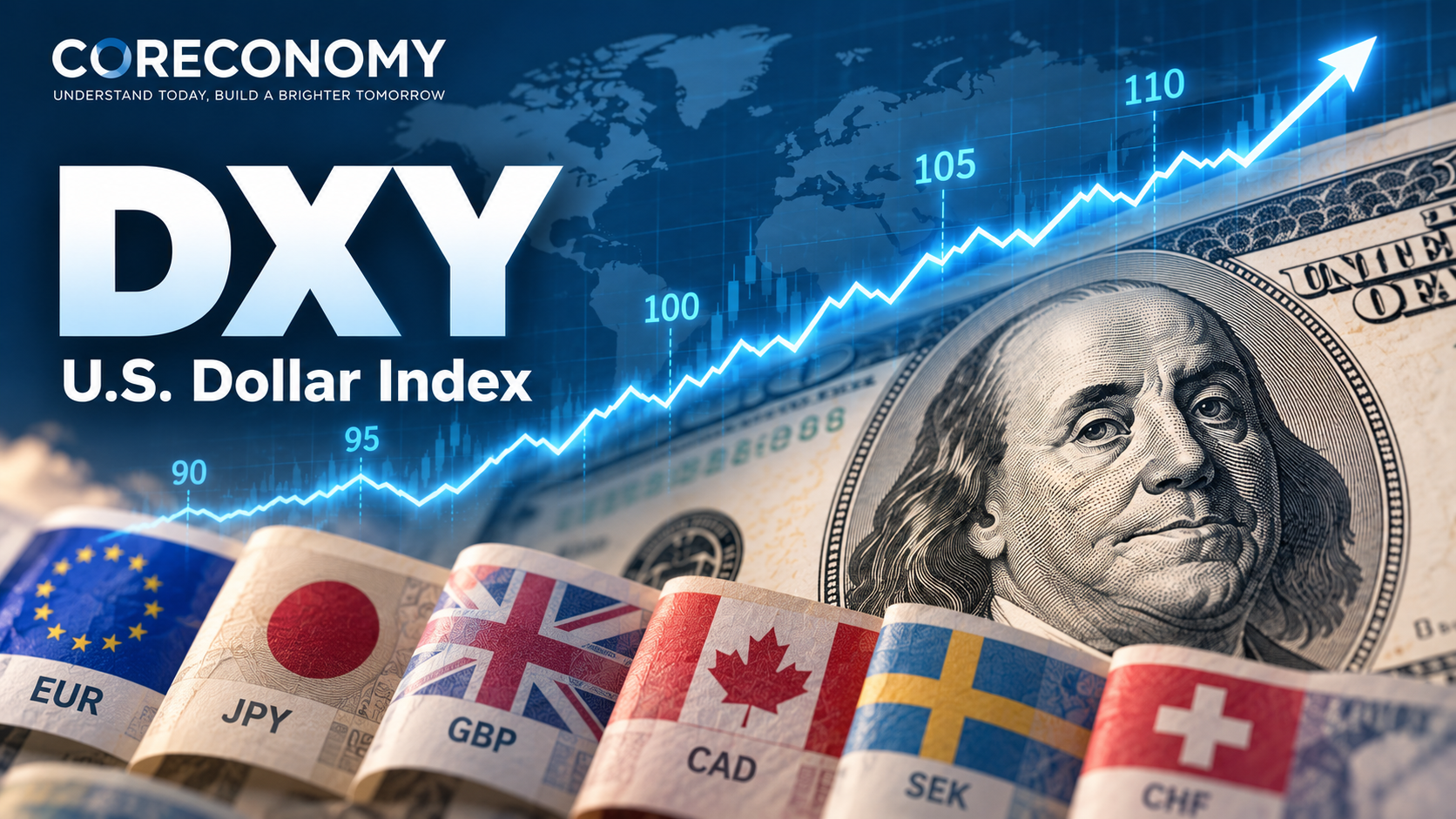
“You may have heard that the Dollar Index has risen above 105.”
Or perhaps:
“The U.S. dollar is strengthening.”
These are common phrases in financial news.
But when you look at the U.S. Dollar Index (DXY) yourself, some questions naturally come up.
If DXY is 100, is the dollar strong? What does 105 mean? What about 110?
And what can you learn by looking at DXY together with U.S. interest rates, the U.S. 10-year Treasury yield, exchange rates, oil prices, and gold prices?
The Dollar Index is more than a number that simply means “the dollar is stronger when it rises and weaker when it falls.”
Three things matter most:
Where is DXY right now?
How quickly has it been moving recently?
How is it moving relative to other economic and financial indicators?
Once you understand these three points, you can use the Dollar Index to make sense of movements in the dollar and global financial markets.
1. What Is the U.S. Dollar Index (DXY)?
The U.S. Dollar Index, commonly called DXY, is an index that measures the relative value of the U.S. dollar against a basket of major foreign currencies.
In simple terms, it answers the question:
“How strong is the U.S. dollar compared with major currencies?”
The widely used ICE U.S. Dollar Index is made up of six currencies.
| Currency | Weight |
|---|---|
| Euro (EUR) | 57.6% |
| Japanese yen (JPY) | 13.6% |
| British pound (GBP) | 11.9% |
| Canadian dollar (CAD) | 9.1% |
| Swedish krona (SEK) | 4.2% |
| Swiss franc (CHF) | 3.6% |
The most important point is that the euro has by far the largest weight at 57.6%.
This means that movements in DXY reflect not only changes in the U.S. dollar itself, but also changes in major currencies such as the euro and Japanese yen.
So DXY does not measure the value of the U.S. dollar against every currency in the world.
It measures the dollar’s relative value against a specific basket of six major currencies.
2. What Does DXY 100 Actually Mean?
This is one of the most important things to understand.
DXY 100 does not mean that the dollar is neither strong nor weak.
It also does not mean:
- 100 = the fair value of the dollar
- 100 = the dividing line between dollar strength and weakness
- 100 = a balanced level for the U.S. economy
DXY was created using March 1973 as its reference period.
Therefore, 100 is a reference value for the index, not an economically determined fair value for the dollar.
So how should you use it?
The basic idea is simple.
Use 100 as a reference point for the dollar’s relative position.
- Above 100 → the dollar’s value is above the index’s 1973 reference level
- Below 100 → the dollar’s value is below the index’s 1973 reference level
This does not mean that the dollar is “100% stronger” or “100% weaker.”
DXY is an index, not a price tag.
For beginners, remember it this way:
100 is a reference point for reading the dollar’s position, not an official dividing line between a strong and weak dollar.
And when looking at the market, it is often more useful to ask where DXY has moved from and where it is going than simply to ask whether it is above or below 100.
3. How Should You Read DXY at 90, 95, 100, 105, or 110?
Here we can create some simple practical reference ranges.
These are not official economic classifications.
They are simply useful ranges for beginners who want to quickly understand the general level of DXY.
| DXY level | How to read the dollar | What it means for beginners |
|---|---|---|
| Below 90 | Very weak dollar environment | The dollar is relatively weak against the major currencies in the index |
| 90–<95 | Weak dollar environment | Dollar weakness is relatively clear |
| 95–<100 | Weak to near-reference environment | The dollar is below the index’s reference level |
| 100–<105 | Relatively strong dollar environment | The dollar is relatively strong against the major currencies |
| 105–<110 | Quite strong dollar environment | Dollar strength may be significant enough to watch its effects on financial markets |
| 110 and above | Very strong dollar environment | It is worth checking whether strong dollar conditions are creating pressure elsewhere in the economy or financial markets |
The table is easy to use.
For example, if DXY is 92:
“The dollar is relatively weak against the major currencies in the index.”
If DXY is 103:
“The dollar is in a relatively strong environment.”
If DXY is 108:
“Dollar strength is quite pronounced. I should check what is happening to interest rates, exchange rates, and other financial markets.”
If DXY is 112:
“The dollar is very strong, so I should look at why it has become this strong and whether the move is creating pressure elsewhere.”
The important point is that DXY above 110 does not automatically mean there is a crisis.
Instead, a very high DXY means that it becomes more important to check how dollar strength is affecting other parts of the economy and financial markets.
4. There Is Something More Important Than the DXY Level
Suppose DXY is 105.
At first glance, that tells us that the dollar is relatively strong.
But these two situations are very different.
Situation A
DXY:
100 → 101 → 102 → 103 → 104 → 105
The increase happened gradually over one year.
Situation B
DXY:
95 → 98 → 102 → 105
The increase happened within two months.
DXY is 105 in both situations.
But the meaning for the market can be very different.
Situation A represents a gradual increase in dollar strength.
Situation B represents a rapid increase in dollar strength.
Therefore, when looking at DXY, ask:
① Where is DXY now?
② How much has it changed over the past month?
③ How much has it changed over the past three months?
For example:
DXY 105 + a 3% increase over three months
could be used as an example of a relatively moderate move.
But:
DXY 105 + a 10% increase over three months
represents a much larger move.
In that situation, do not stop at:
“The dollar is strong.”
Instead, ask:
“Why has the dollar strengthened so quickly?”
That question is often more useful.
5. How Should Beginners Read DXY?
If you are looking at DXY for the first time, you do not need to start with complicated economic models.
Use the following steps.
Step 1: Check the current level
Suppose DXY is 103.
Start with:
“The dollar is currently in a relatively strong environment.”
Step 2: Check the recent direction
If DXY was 98 one month ago:
“DXY has risen from 98 to 103, so the dollar has strengthened recently.”
Step 3: Check the speed of the move
If DXY rose five points in one month:
“The dollar has strengthened relatively quickly.”
Step 4: Check U.S. interest rates and rate expectations
If U.S. interest rates or rate expectations have also risen:
“Higher U.S. interest rates may be one of the important reasons supporting the stronger dollar.”
Step 5: Check the exchange rate against your local currency
If the local-currency price of the U.S. dollar has also risen:
“Broad dollar strength and weakness in the local currency are occurring at the same time.”
This simple process is already much more useful than looking at DXY as a number by itself.
6. How Should You Read DXY Together With U.S. Interest Rates?
This is one of the first combinations worth checking.
The key question is:
“Are higher U.S. interest rates supporting dollar strength?”
| DXY | U.S. interest rates / rate expectations | Basic interpretation |
|---|---|---|
| Rising | Rising | Higher U.S. interest rates may be supporting dollar strength |
| Rising | Falling | Look for other reasons behind the stronger dollar |
| Falling | Rising | Look for reasons why the dollar is weakening despite higher rates |
| Falling | Falling | Lower U.S. interest rates and dollar weakness are occurring together |
For example, if DXY rises from 100 to 105 while U.S. interest rates are also rising, you can ask:
“Is the increase in U.S. interest rates making dollar-denominated assets relatively more attractive?”
On the other hand, if DXY rises from 100 to 105 while U.S. interest rates are falling:
“The dollar is strengthening even though U.S. interest rates are falling. What other factors could be driving the dollar?”
At that point, you can look at factors such as interest rates and economic conditions in Europe and Japan, as well as global demand for safer assets.
7. What If You Look at DXY and the U.S. 10-Year Treasury Yield Together?
The U.S. policy rate is the interest rate set by the central bank.
The U.S. 10-year Treasury yield, on the other hand, reflects market expectations about longer-term interest rates, growth, inflation, and other factors.
Looking at DXY and the 10-year Treasury yield together can therefore help you see whether dollar strength is occurring alongside higher long-term U.S. yields.
| DXY | U.S. 10-year Treasury yield | How to read it |
|---|---|---|
| Rising | Rising | Higher U.S. yields and dollar strength are occurring together |
| Falling | Falling | Lower U.S. yields and dollar weakness are occurring together |
| Rising | Falling | Check whether factors other than yields are supporting the dollar |
| Falling | Rising | Look for reasons why the dollar is weakening despite higher yields |
For example:
DXY: 100 → 105
10-year Treasury yield: 4.0% → 4.5%
The first observation is straightforward:
“The U.S. long-term Treasury yield is rising while the dollar is also strengthening.”
You can then ask whether rising U.S. yields are helping support the stronger dollar.
Now consider the opposite:
DXY: 100 → 105
10-year Treasury yield: 4.5% → 4.0%
Then:
“The U.S. long-term Treasury yield is falling, but the dollar is still strengthening.”
This tells you to look for other factors that may be supporting the dollar.
8. What Can DXY and an Exchange Rate Tell You Together?
DXY measures the U.S. dollar against the six currencies in its basket.
An exchange rate measures the dollar against a specific currency.
Looking at the two together can therefore help you separate broad dollar movements from movements in an individual currency.
For clarity, in the examples below, the exchange rate means the local-currency price of one U.S. dollar.
| DXY | Local-currency price of USD | How to read it |
|---|---|---|
| Rising | Rising | Broad dollar strength + weakness in the local currency |
| Falling | Falling | Broad dollar weakness + strength in the local currency |
| Rising | Falling | The dollar is strong globally, but the local currency is relatively strong against it |
| Falling | Rising | The dollar is weaker globally, but the local currency is even weaker |
The last combination is especially important.
DXY falling + local-currency price of USD rising
Suppose:
- DXY: 105 → 100
- Local-currency price of USD: 1.35 → 1.40
The dollar has weakened against the currencies in the DXY basket, but the dollar has become more expensive in the local market.
In this case, you can ask:
“Is the local currency weakening more than the major currencies included in DXY?”
This is one of the most useful reasons to look at DXY together with an exchange rate.
DXY tells you about broad dollar strength.
A specific exchange rate tells you about the relationship between the dollar and one particular currency.
9. What If You Look at DXY and Oil Prices Together?
Oil is generally priced in U.S. dollars.
Therefore, when the dollar strengthens, buying oil can become more expensive for countries and buyers using other currencies.
However, oil prices are also heavily affected by factors such as supply, demand, producer decisions, and geopolitical risks.
So beginners can start with the following framework.
| DXY | Oil price | What to check first |
|---|---|---|
| Rising | Falling | Check whether dollar strength is occurring alongside weaker demand for commodities |
| Rising | Rising | Check whether supply disruptions or geopolitical risks are pushing oil higher despite dollar strength |
| Falling | Rising | Consider whether a weaker dollar and stronger commodity prices are occurring together |
| Falling | Falling | Check whether weaker global demand is affecting both the dollar and oil |
For example, if DXY rises sharply while oil prices fall significantly, you can look beyond dollar strength and ask whether concerns about global economic growth and oil demand are also playing a role.
On the other hand, if DXY is strong while oil prices are also rising sharply, supply disruptions or geopolitical risks may be stronger forces than the effect of the stronger dollar.
10. What If You Look at DXY and Gold Together?
Gold is another asset that is often discussed alongside the U.S. dollar.
In general, a stronger dollar can put downward pressure on the price of gold because gold is priced in dollars.
But gold prices are also influenced by many other factors.
Beginners can start with the following framework.
| DXY | Gold price | What to check first |
|---|---|---|
| Rising | Falling | Check whether a stronger dollar is occurring alongside weaker gold prices |
| Falling | Rising | Consider whether dollar weakness and stronger gold prices are occurring together |
| Rising | Rising | Check whether safe-haven demand or other factors are outweighing the effect of dollar strength |
| Falling | Falling | Look at interest rates, risk appetite, and other factors |
One combination is particularly interesting:
DXY rising + gold rising
If the dollar is strengthening while gold is also rising, it becomes harder to explain gold prices using dollar movements alone.
In that case, you can also consider factors such as:
- demand for safe-haven assets
- geopolitical risks
- real interest rates
This is why DXY should not be used as a single-variable explanation for gold prices.
11. What Does a High DXY Mean for the Economy?
If DXY is high and continuing to rise, it is useful to look at exchange rates and the broader economy.
For example, suppose:
- DXY: 100 → 108
- The dollar also strengthens against a particular local currency.
This represents an environment of broad dollar strength combined with weakness in that local currency.
In such an environment, goods priced in dollars can become more expensive in local-currency terms.
This can include:
- oil
- raw materials
- components
- other imported goods
For businesses that rely heavily on imports, this can increase costs.
On the other hand, exporters may benefit when the same foreign-currency revenue is converted into more local currency because the local currency has weakened.
So a weaker local currency is not automatically good or bad for every company.
The effect depends on factors such as whether a company earns revenue in foreign currencies, how much it imports, and how much of its costs are affected by exchange rates.
At the broader economic level, a weaker local currency can also raise the local-currency cost of imported goods and potentially add upward pressure to inflation.
12. The Most Useful Table for Reading DXY
Now let’s bring everything together into one practical table.
This table is designed to answer the beginner’s most important question:
“I am looking at DXY. What can I learn from it?”
| What to check | Situation | First interpretation |
|---|---|---|
| DXY level | Below 90 | Very weak dollar environment |
| DXY level | 90–<95 | Weak dollar environment |
| DXY level | 95–<100 | Dollar below its reference level |
| DXY level | 100–<105 | Relatively strong dollar environment |
| DXY level | 105–<110 | Quite strong dollar environment |
| DXY level | 110+ | Very strong dollar environment |
| Recent movement | Sharp rise | Dollar strength is developing quickly |
| Recent movement | Sharp fall | Dollar weakness is developing quickly |
| DXY ↑ + U.S. interest rates ↑ | Moving together | Check whether higher U.S. rates are supporting dollar strength |
| DXY ↑ + U.S. interest rates ↓ | Moving in opposite directions | Look for other reasons behind dollar strength |
| DXY ↑ + local-currency price of USD ↑ | Moving together | Broad dollar strength + local currency weakness |
| DXY ↓ + local-currency price of USD ↑ | Moving in opposite directions | Check whether the local currency is weakening more than the major currencies in DXY |
| DXY ↑ + oil ↓ | Moving in opposite directions | Check for weaker commodity demand or economic growth concerns |
| DXY ↑ + oil ↑ | Moving together | Check for supply or geopolitical factors |
| DXY ↑ + gold ↓ | Moving in opposite directions | Check whether a stronger dollar is occurring alongside weaker gold prices |
| DXY ↑ + gold ↑ | Moving together | Check for safe-haven demand or other factors |
The key is to read the DXY level first and then check whether other indicators are moving in the same or opposite direction.
13. Let’s Work Through a Realistic Example
Suppose the market looks like this:
- DXY: 98 → 105
- U.S. policy rate: remains at a high level
- U.S. 10-year Treasury yield: 4.0% → 4.5%
- Local-currency price of USD: 1.30 → 1.38
- Gold price: falling
- Oil price: falling
A beginner can work through the situation step by step.
First
DXY has risen from 98 to 105.
→ The dollar has strengthened.
Second
The 10-year Treasury yield has also risen.
→ Higher U.S. yields and dollar strength are occurring together.
Third
The local-currency price of the dollar has also risen.
→ The local currency has weakened against the dollar.
Fourth
Gold prices have fallen.
→ Dollar strength and weaker gold prices are occurring together.
Fifth
Oil prices have also fallen.
→ You can check whether dollar strength is occurring alongside weaker commodity demand.
So, from a beginner’s perspective, you could summarize the situation like this:
“The dollar is strengthening while U.S. interest rates remain relatively high, and the effects of dollar strength are also appearing in exchange rates and commodity markets.”
That is already much more useful than simply saying:
“DXY is 105.”
14. Let’s Look at the Opposite Situation
Now suppose the market looks like this:
- DXY: 106 → 100
- U.S. interest rates: falling
- U.S. 10-year Treasury yield: 4.5% → 4.0%
- Local-currency price of USD: 1.40 → 1.33
- Gold price: rising
This situation is easier to interpret.
DXY falling
→ The dollar is weakening.
U.S. interest rates falling
→ The relative attractiveness of U.S. interest-bearing assets may be declining.
10-year Treasury yield falling
→ Long-term U.S. yields are also falling.
Local-currency price of USD falling
→ The local currency is strengthening against the dollar.
Gold price rising
→ Dollar weakness and stronger gold prices are occurring together.
So you could summarize the situation as:
“U.S. interest rates are falling while the dollar is weakening, while the local currency and gold are strengthening relative to the dollar.”
15. Remember These Three Steps When Looking at DXY
You do not need to look at every economic indicator at once.
At first, these three steps are enough.
① Check the DXY level
Is it above or below 100?
- Above 100 → the dollar is above its 1973 reference level
- Below 100 → the dollar is below its 1973 reference level
- 105 or higher → a relatively strong dollar environment for practical reference
- 110 or higher → a very strong dollar environment for practical reference
② Check the recent movement
Is DXY rising or falling?
Also look at the size of the move when possible.
- Gradual rise → gradual dollar strengthening
- Rapid rise → a strong increase in dollar strength
- Rapid fall → dollar weakness is developing quickly
③ Check U.S. interest rates and an exchange rate
These two additional pieces of information can significantly improve your interpretation.
DXY ↑ + U.S. interest rates ↑
→ Check whether higher U.S. interest rates are supporting dollar strength.
DXY ↑ + local-currency price of USD ↑
→ Broad dollar strength and weakness in the local currency are occurring together.
DXY ↓ + local-currency price of USD ↑
→ Check whether the local currency is weakening more than the major currencies included in DXY.
You do not need to add oil and gold immediately.
Start with:
DXY → U.S. interest rates → exchange rates
Once you are comfortable with those three, you can add the 10-year Treasury yield, oil, and gold when necessary.
16. Common Misunderstandings About the Dollar Index
“If DXY is above 100, the dollar is expensive.”
Not exactly.
100 is a reference value, not a measure of whether the dollar is fairly priced.
“If DXY is 110, the U.S. economy must be doing well.”
You cannot determine that from DXY alone.
DXY can be affected by U.S. interest rates, monetary policy, economic conditions in other countries, demand for safer assets, and many other factors.
“If DXY rises, stocks must fall.”
Not necessarily.
However, a strong dollar can create pressure for some companies and emerging-market financial markets, so it is worth checking the broader environment.
“If DXY rises, gold must fall.”
Not necessarily.
Gold is also affected by real interest rates, demand for safe-haven assets, geopolitical risks, and other factors.
“If the dollar exchange rate rises, DXY must also rise.”
No.
DXY does not include every currency.
A specific currency can weaken more than the currencies included in the DXY basket, causing its local-currency price of the dollar to rise even when DXY is falling.
17. How Should You Actually Use DXY?
The purpose of looking at the Dollar Index is not to predict the future of the economy using one number.
Instead, use it as a starting point.
For example:
DXY is 103.
→ The dollar is relatively strong.
It was 98 one month ago.
→ The dollar has strengthened recently.
The U.S. 10-year Treasury yield also rose from 4.0% to 4.5%.
→ Higher U.S. yields and dollar strength are occurring together.
The local-currency price of the dollar also rose from 1.30 to 1.38.
→ The local currency has weakened against the dollar.
At this point, even a beginner can already understand quite a lot about the market.
If necessary, you can then add oil and gold.
The important thing is to add indicators step by step instead of trying to analyze everything at once.
18. Limitations of the Dollar Index
DXY has several important limitations.
First, your local currency may not be included in the index.
Therefore, if you want to understand how strong the dollar is against a particular currency, you should also look at that currency’s exchange rate against the dollar.
Second, the euro has a 57.6% weight in DXY.
This means movements in the euro-dollar exchange rate can have a significant effect on the Dollar Index.
Third, the index uses March 1973 as its reference period.
Therefore, you should not interpret 100 as the fair value of the dollar in today’s economy.
Fourth, a high DXY does not necessarily mean that the U.S. economy is strong, and a low DXY does not necessarily mean that the U.S. economy is weak.
These limitations do not make DXY useless.
Instead, DXY can be very useful as a starting point for understanding the dollar’s relative strength and direction, and for connecting dollar movements with U.S. interest rates and exchange rates.
19. The Dollar Index in One Sentence
The U.S. Dollar Index (DXY) measures the relative strength of the U.S. dollar against a basket of major currencies, and beginners can understand its movements more easily by looking at the current level, recent changes, U.S. interest rates, and exchange rates in that order.
If DXY is above 100, the dollar is above its 1973 reference level.
If DXY is below 100, the dollar is below its 1973 reference level.
For practical reference, a DXY level above 105 can be viewed as a relatively strong dollar environment, while 110 or higher represents a very strong dollar environment.
However, the number itself is only part of the story.
It is also important to look at how quickly DXY has been moving.
If DXY and U.S. interest rates are rising together, check whether higher interest rates are supporting dollar strength.
If DXY and the local-currency price of the dollar against a particular currency are both rising, broad dollar strength and weakness in that local currency may be occurring at the same time.
Ultimately, three questions matter most when you look at DXY:
How strong is the dollar right now?
How quickly has it been changing?
Are U.S. interest rates and exchange rates moving in the same direction?
Once you start with these three questions, the Dollar Index becomes more than a number appearing in financial news.
It becomes a useful economic indicator for understanding the broader direction of global financial markets.
Key Takeaways
- DXY measures the relative strength of the U.S. dollar against a basket of six major currencies.
- The euro has the largest weight at 57.6%.
- DXY 100 is a reference value, not the fair value of the dollar.
- A DXY above 100 means the index is above its March 1973 reference level, while a DXY below 100 means it is below that reference level.
- For practical reference, below 90 can be viewed as a very weak dollar environment, 90–<95 as weak, 100–<105 as relatively strong, 105–<110 as quite strong, and 110 or above as very strong.
- However, the DXY level alone is not enough. The speed and direction of recent changes also matter.
- DXY rising + U.S. interest rates rising → Check whether higher U.S. rates are supporting dollar strength.
- DXY rising + local-currency price of USD rising → Broad dollar strength and weakness in the local currency may be occurring together.
- DXY falling + local-currency price of USD rising → Check whether the local currency is weakening more than the major currencies included in DXY.
- DXY rising + oil falling → Check whether dollar strength is occurring alongside weaker commodity demand or economic growth concerns.
- DXY rising + gold rising → Check whether safe-haven demand or other factors are supporting gold despite dollar strength.
- Beginners can start with DXY → U.S. interest rates → exchange rates, and then add the 10-year Treasury yield, oil, and gold when needed.