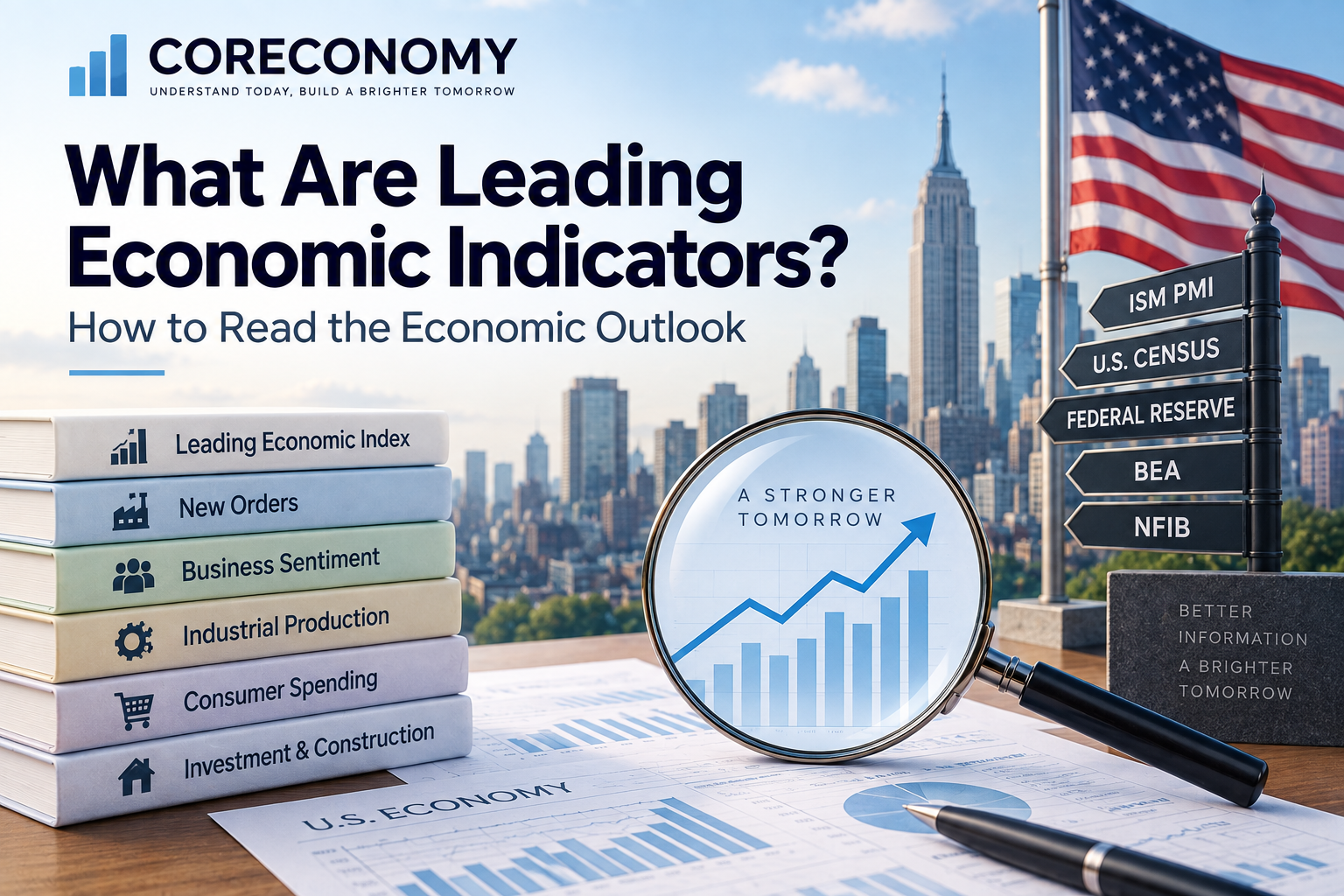
When you read economic news, you often see phrases such as “leading economic indicators are weakening” or “leading indicators are pointing to a slowdown.”
But what exactly are leading economic indicators?
Where can you find them, and how should you interpret them when they move?
Leading economic indicators are not numbers that can predict the future of the economy with certainty.
Instead, they are economic measures that tend to change before broader economic activity changes. They can therefore help us look for early signs of where the economy may be heading.
The important point is that you should not look at whether one indicator simply went up or down.
You need to look at the recent trend, whether other indicators are moving in the same direction, and whether actual economic activity is beginning to confirm the signal.
1. What Are Leading Economic Indicators?
A leading economic indicator is an economic measure that tends to move before changes in overall economic activity.
The key word is “tends.”
A leading indicator does not tell us exactly what will happen next.
For example, imagine that manufacturers begin receiving fewer new orders.
If companies receive fewer orders for their products, they may eventually reduce production. Lower production can then affect investment, hiring, and other parts of the economy.
In this situation, new orders may weaken before actual production declines.
That makes new orders useful when looking for early signs of a possible change in manufacturing activity.
This is the basic idea behind leading economic indicators.
In simple terms, a leading indicator is not:
“A number that tells us exactly what the economy will do next.”
It is closer to:
“A signal that we watch because it may change before broader economic activity does.”
2. How Are Leading, Coincident, and Lagging Indicators Different?
Economic indicators can also be grouped according to when they tend to move relative to the business cycle.
Leading indicators
Leading indicators tend to move before changes in economic activity.
They are used to look for early signs of a change in the economic outlook.
Coincident indicators
Coincident indicators tend to move around the same time as current economic activity.
They help us understand what is happening in the economy right now.
Lagging indicators
Lagging indicators tend to change after broader economic conditions have already changed.
They can help confirm changes that have already taken place.
The distinction can be summarized simply:
| Type | Relationship with the economy | Main purpose |
|---|---|---|
| Leading | Tends to move before economic activity changes | Look for the direction of future activity |
| Coincident | Moves with current economic activity | Understand current conditions |
| Lagging | Tends to move after economic activity changes | Confirm changes that have already occurred |
This is why looking only at leading indicators is not enough.
The most useful approach is to connect leading indicators with measures of current economic activity.
3. Where Can You Check Leading Economic Indicators in the United States?
If you want to monitor the U.S. economy yourself, several major data sources are useful.
One useful place to start is the Conference Board’s Leading Economic Index, or LEI.
The U.S. LEI combines multiple economic indicators into a single measure designed to identify turning points in the business cycle.
Its components include measures such as manufacturers’ new orders, the ISM New Orders Index, building permits, stock prices, credit conditions, the yield spread, and consumer expectations.
Because the LEI combines several indicators, it can provide a broader view than any single economic measure.
For individual indicators, several U.S. government and private-sector sources are also useful.
The U.S. Census Bureau publishes manufacturers’ shipments, inventories, and orders, including new orders.
The Institute for Supply Management publishes the ISM Manufacturing PMI, which includes a New Orders Index.
The Federal Reserve publishes Industrial Production data.
The Bureau of Economic Analysis publishes personal consumption expenditures, which measure consumer spending.
The Census Bureau also publishes construction spending and housing data.
For small-business sentiment, the NFIB Small Business Optimism Index provides survey-based information about how small-business owners view current and future business conditions.
These sources answer different questions, so they should not be treated as interchangeable.
4. What Should You Look at?
Rather than trying to memorize dozens of economic indicators, it is easier to think about the question each indicator is trying to answer.
1. The Leading Economic Index
Start with the overall direction of the Conference Board LEI.
Is it rising?
Is it falling?
Or is it moving without a clear direction?
A single monthly change is not enough to establish a trend.
Instead, look at whether the movement has continued over several months.
The goal is not to treat every decline as a warning of recession.
The goal is to determine whether the broader leading signal is becoming consistently weaker or stronger.
2. New Orders
Next, look at new orders.
New orders provide information about demand that may translate into future production.
The U.S. Census Bureau’s Manufacturers’ Shipments, Inventories, and Orders survey provides monthly data on manufacturing orders. The ISM Manufacturing PMI also includes a New Orders Index.
If new orders are rising, manufacturers may have more demand to fulfill in the future.
If new orders are falling persistently, it may be worth watching whether production eventually weakens as well.
The key is persistence.
A one-month decline does not necessarily mean that the manufacturing cycle has turned.
A sustained decline is more meaningful than an isolated monthly move.
3. Small-Business Sentiment
The next question is how small businesses themselves view the economy.
The NFIB Small Business Optimism Index is one U.S. measure that can help answer this question.
It is based on a monthly survey of small-business owners and includes expectations about business conditions, sales, hiring, capital spending, and other areas.
Small-business sentiment is different from actual economic activity.
A business owner can become more cautious before reducing production or investment.
On the other hand, businesses can remain optimistic even when some current economic data are already weakening.
That is why sentiment should be treated as one part of the overall picture rather than as a standalone forecast.
4. Industrial Production
Next, check what is actually happening in production.
The Federal Reserve publishes monthly Industrial Production data covering manufacturing, mining, and utilities.
Production is closer to a measure of current economic activity than a pure leading indicator.
That makes it useful for checking whether the signals seen in leading indicators are beginning to show up in the real economy.
For example, if new orders have weakened for several months but industrial production remains stable, the weakness in demand has not necessarily translated into a broad production slowdown yet.
5. Consumer Spending
Business activity is only one side of the economy.
Consumer spending is another major part of economic activity.
The Bureau of Economic Analysis publishes personal consumption expenditures, or PCE, which measure spending on goods and services by or on behalf of U.S. residents.
If consumer spending continues to grow while some leading indicators weaken, the economy may not yet be experiencing a broad slowdown.
If both consumer spending and business activity weaken, the signal becomes broader and deserves closer attention.
6. Investment and Construction
Business investment and construction activity can also provide useful information.
The Census Bureau publishes data on construction spending as well as housing-related measures such as building permits, housing starts, and new home sales.
Manufacturers’ orders data also include measures related to capital goods, which can help track business investment demand.
These indicators can help answer another important question:
Are businesses and households still committing resources to future economic activity?
If investment and construction weaken alongside new orders and small-business sentiment, the slowdown may be spreading beyond one part of the economy.
5. How Should You Actually Interpret the Signals?
This is the most important part.
The purpose of leading indicators is not to look at one number and immediately decide that the economy is getting better or worse.
A more useful approach is to work through the indicators in sequence.
Step 1: Check the direction of the LEI
Start with the Conference Board LEI.
Is the overall leading signal improving or weakening?
Then ask whether the change is temporary or part of a broader trend.
Do not make a conclusion based on one monthly reading.
Step 2: Check new orders
If the LEI is weakening, check whether manufacturing new orders are also weakening.
If new orders are declining persistently, it is reasonable to watch for a later slowdown in production.
But if the LEI is weakening while new orders are still rising, the indicators are sending different signals.
In that situation, do not automatically choose one indicator and ignore the other.
Look at what is driving the difference.
Step 3: Check small-business sentiment
Next, see whether small-business sentiment is moving in the same direction.
If new orders and small-business sentiment are both weakening, businesses may be becoming more cautious at the same time that demand is softening.
If new orders weaken while small-business sentiment improves, the two signals are less consistent.
That does not tell you which one is “right.”
It tells you that more information is needed.
Step 4: Check actual production and spending
Now look at current economic activity.
Check industrial production and consumer spending.
If leading indicators have weakened but production and consumer spending remain solid, the early warning signals have not yet translated into a broad decline in current activity.
If production and consumer spending also begin to weaken, the slowdown may be becoming more widespread.
6. Here Is How You Can Read Different Scenarios
Consider a hypothetical situation.
LEI ↓
New orders ↓
Small-business sentiment ↓
Industrial production →
Consumer spending →
In this situation, several forward-looking indicators are weakening.
But current production and consumer spending have not clearly declined.
It would be premature to call this a recession.
A more appropriate interpretation would be:
“Several early indicators are weakening, so it is worth watching whether the weakness spreads into actual economic activity.”
Now consider another situation.
LEI ↓
New orders ↓
Small-business sentiment ↓
Industrial production ↓
Consumer spending ↓
This is different.
The weakness is no longer limited to leading indicators.
Current economic activity is also weakening.
That does not mean one can automatically declare a recession, but it does mean the possibility of a broader economic slowdown deserves much closer attention.
Now consider the opposite situation.
LEI ↓
New orders ↑
Small-business sentiment ↑
Industrial production ↑
Consumer spending ↑
Here the indicators are moving in different directions.
In this case, it would be misleading to look at the falling LEI alone and conclude that the entire economy is deteriorating.
Instead, the next question should be why the different indicators are sending different signals.
This is the most important principle when using leading economic indicators:
Do not ask what one indicator says. Ask whether several indicators are telling the same story.
7. Does a Falling Leading Indicator Mean a Recession Is Coming?
Not necessarily.
Leading indicators are useful for monitoring the economic outlook, but they do not determine whether a recession will occur.
Even the Conference Board LEI is a composite measure made up of multiple components.
A decline in the LEI can be a reason to examine the economic outlook more carefully, but it is not by itself proof that a recession has begun.
To understand whether the economy is actually entering a recession, you need to look at broader economic activity, including production, consumer spending, employment, income, and investment.
For a deeper explanation of what a recession is and how it affects the economy, see our article on what a recession means.
8. The Limitations of Leading Economic Indicators
Leading indicators have several important limitations.
First, not every leading indicator moves at exactly the same time.
Some indicators may turn earlier than others, and the strength of their relationship with the business cycle can vary.
Second, leading indicators do not predict the future with certainty.
Unexpected changes in monetary policy, financial markets, energy prices, trade conditions, or geopolitical events can change the direction of the economy.
Third, economic data can be revised.
An initial estimate may change as additional information becomes available, so it is important not to build a long-term conclusion around a single preliminary release.
Fourth, different indicators measure different parts of the economy.
New orders provide information about incoming demand for manufactured goods and future production commitments.
Small-business sentiment reflects how companies view their conditions and outlook.
Industrial production measures actual output.
Consumer spending measures household economic activity.
Construction data show activity in another important part of the economy.
Understanding what each indicator actually measures is therefore just as important as knowing whether its latest number went up or down.
9. Four Things to Remember
If you are new to leading economic indicators, remember these four principles.
- Look at trends rather than one-month changes.
- Compare several indicators instead of relying on one number.
- Use new orders and small-business sentiment to look for changes in future business activity.
- Check whether production and consumer spending eventually confirm the earlier signal.
The purpose of leading economic indicators is not to predict the economy perfectly.
Their purpose is to help you notice possible changes early and then check whether those signals are confirmed by actual economic activity.
10. Leading Economic Indicators, in Simple Terms
Leading economic indicators are not numbers that reveal the future with certainty.
They are economic measures that tend to move before broader economic activity and can therefore help us monitor the direction of the economy.
For the United States, the Conference Board LEI provides a broad composite view of leading economic conditions.
The U.S. Census Bureau provides manufacturing orders and construction data.
ISM provides the Manufacturing PMI and New Orders Index.
The NFIB Small Business Optimism Index provides information about small-business sentiment.
The Federal Reserve provides industrial production data.
The Bureau of Economic Analysis provides personal consumption expenditure data.
A practical way to use these indicators is:
Check the direction of the LEI.
→ Check whether new orders are moving in the same direction.
→ Check small-business sentiment.
→ Check whether industrial production and consumer spending are following the same trend.
→ Then ask whether the overall pattern has persisted long enough to represent a meaningful change.
This approach is more useful than treating any single indicator as a prediction of the future.
It turns leading economic indicators into what they are most useful for: an early-warning framework for understanding where the economy may be heading and deciding what to examine next.