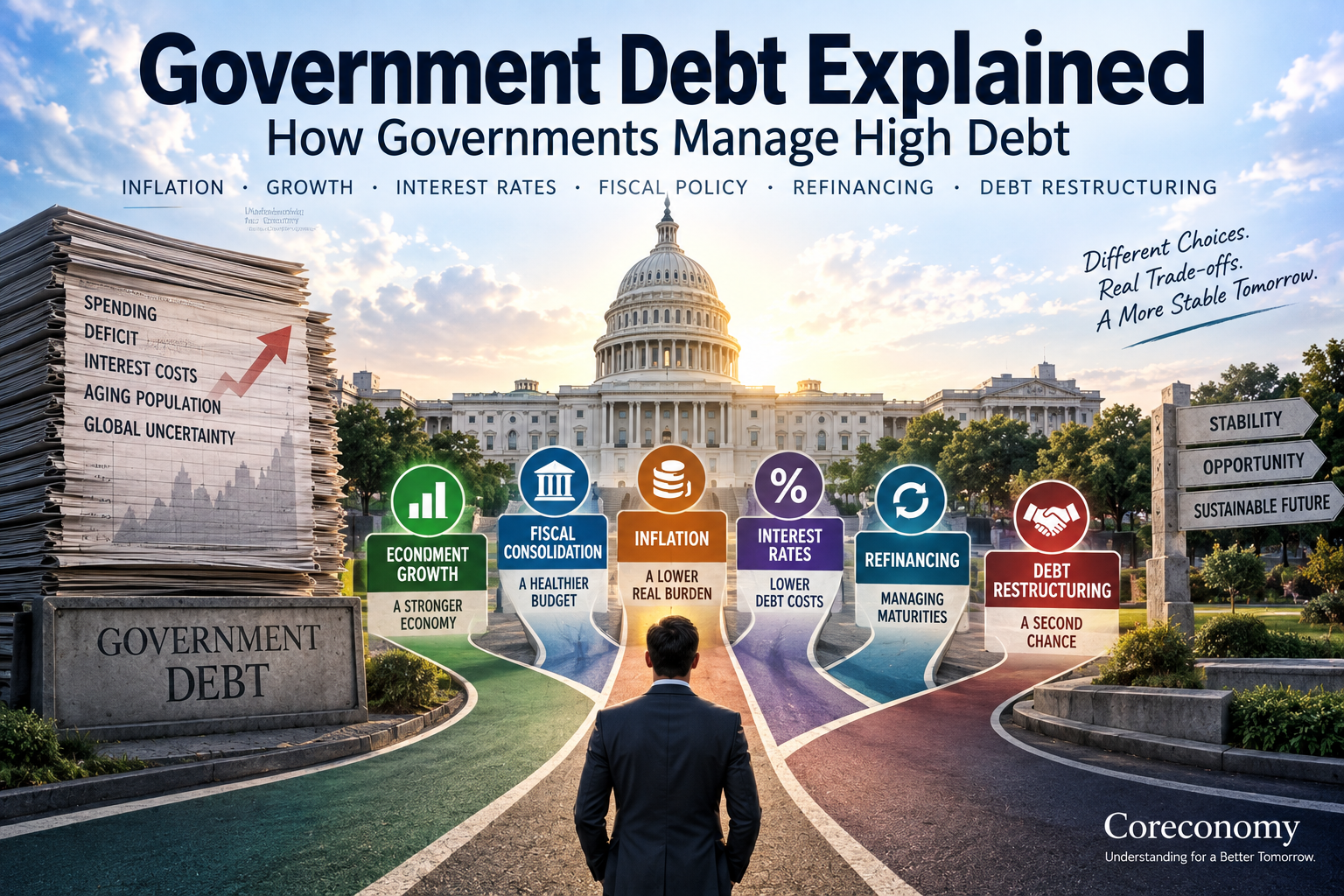
In the previous articles, we looked at credit and national debt, and how both affect the economy.
Credit can increase purchasing power and support:
Borrowing
↓
Spending and investment
↓
Economic activity
↓
Income and growth
But when debt grows much faster than the income available to service it, the situation can become more difficult.
A highly indebted government may face:
Higher interest costs
↓
Less fiscal flexibility
↓
Pressure on spending and taxes
↓
Slower economic growth
So an important question follows:
What can a government actually do when its debt burden becomes large?
You may hear statements such as:
“Inflation can reduce the real value of debt.”
“Governments can refinance old bonds with new ones.”
“Lower interest rates can make debt easier to manage.”
“Governments can cut spending or restructure their debt.”
All of these ideas contain some truth.
But none is a magic solution.
Every option comes with:
Benefits + Costs + Trade-offs
This guide explains the main ways governments can manage high debt in simple terms.
1. Does Government Debt Have to Reach Zero?
Not necessarily.
Think about a person with a mortgage.
The normal goal is eventually:
Debt → $0
But governments operate continuously, so their finances do not have a natural end point.
Every year, governments:
- Collect taxes
- Provide public services
- Invest in infrastructure
- Pay pensions and benefits
- Fund defense
- Respond to recessions and emergencies
Government finances therefore continue from year to year.
Governments can issue bonds, allow older bonds to mature, and issue new bonds over time.
So the important question is not:
“Does the government have debt?”
but:
“Can the government continue to manage and service its debt?”
That is the more useful way to think about public debt.
If you want to understand why governments continue to carry debt and how refinancing works, see Why Does National Debt Keep Rising?
Before looking deeper into government debt management, it also helps to understand how credit and borrowing work in the economy. See What Is Credit? for a simple explanation.
2. Why Does Debt Become a Problem?
A large amount of debt does not automatically mean a government is in trouble.
Imagine a government with:
GDP = $1 trillion
Government debt = $500 billion
Its debt-to-GDP ratio is:
50%
Now imagine another government with exactly the same numbers.
At first glance, they look identical.
But suppose:
Government A
Average borrowing cost:
2%
Government B
Average borrowing cost:
8%
Using a simple calculation:
Government A:
$500 billion × 2%
= $10 billion
Government B:
$500 billion × 8%
= $40 billion
The debt is exactly the same.
But the annual interest burden is four times larger for Government B.
This is why looking only at:
“How much debt does the government have?”
is not enough.
3. What Should We Look at Besides the Debt Number?
To understand whether public debt is manageable, look at several things together.
① Debt level
How much has the government borrowed?
② Debt relative to GDP
How large is the debt compared with the overall economy?
③ Interest costs
How much does the government have to spend servicing its debt?
④ Economic growth
Is the economy growing fast enough to support rising debt?
⑤ Debt maturity
When do the bonds mature?
Are large amounts coming due at the same time?
⑥ Currency
Is the government borrowing in its own currency or a foreign currency?
These factors can produce very different situations even when two countries have similar debt-to-GDP ratios.
4. The First Option: Grow the Economy Faster Than the Debt
One of the most favorable ways to reduce a debt burden is relatively simple:
Grow the economy and income faster than debt.
Imagine:
Today
GDP:
$1 trillion
Government debt:
$500 billion
Debt-to-GDP:
50%
Now suppose several years later:
GDP:
$1.3 trillion
Government debt:
$550 billion
The government has more debt in absolute terms.
But:
$550 billion ÷ $1.3 trillion ≈ 42%
The debt-to-GDP ratio has actually fallen.
This is an important idea:
A government can increase its debt in dollar terms while reducing its debt burden relative to the size of the economy.
Economic growth therefore plays an important role in debt sustainability.
5. But Can Governments Simply Wait for Economic Growth?
Unfortunately, growth is not guaranteed.
An economy may face:
- An aging population
- A shrinking workforce
- Weak productivity growth
- Low investment
- Geopolitical shocks
- Recessions
And a heavy debt burden can itself make growth more difficult if interest costs consume an increasing share of government resources.
So governments may need to manage both:
Economic growth
and:
The debt itself
at the same time.
6. The Second Option: Reduce the Budget Deficit
One of the simplest reasons government debt keeps rising is:
The government spends more than it collects in revenue.
Imagine:
Government revenue = $100
and:
Government spending = $120
The government has:
A $20 budget deficit
If that deficit is financed by issuing bonds, government debt can increase.
To slow the growth of debt, a government can try to:
Increase revenue
+
Reduce spending
+
Or do both
This is often called:
Fiscal consolidation
In simple terms, it means improving the government’s budget balance.
7. Why Can Fiscal Consolidation Be Painful?
Reducing a budget deficit sounds simple.
But there is a trade-off.
Suppose a government:
Cuts spending
+
Raises taxes
The government’s budget balance may improve.
But the economy may also experience:
Lower government spending
↓
Lower private-sector demand
↓
Lower business revenue
↓
Slower economic growth
This can be especially difficult during a recession.
So the real question is not simply:
“Should the government reduce its deficit?”
It is:
“When should it do it, how quickly, and which taxes or spending programs should change?”
Timing matters.
8. The Third Option: Inflation Can Reduce the Real Burden of Debt
Now consider inflation.
Imagine a government has:
$100 billion of fixed nominal debt
The number itself does not change.
But if prices rise significantly over time, the purchasing power of money falls.
In simple terms:
$1 million today
and:
$1 million after many years of high inflation
have the same numerical value but may buy very different amounts of goods and services.
This means that for a borrower with fixed nominal debt:
Higher inflation can reduce the real value of the debt.
This is often described as:
Inflating away the debt
But this phrase can be misleading if it makes the process sound easy or intentional.
9. Can a Government Simply Create High Inflation to Reduce Its Debt?
Not without serious consequences.
Inflation does not only affect borrowers.
It also affects:
- Bondholders
- Savers
- Workers
- Consumers
- Businesses
Imagine an investor owns a bond paying:
3% interest
If inflation unexpectedly becomes much higher, the investor’s real return can become very small or even negative.
The borrower may benefit because the real value of the fixed debt declines.
But the lender loses purchasing power.
High inflation can also lead to:
Lower real incomes
↓
Higher interest rates
↓
Financial-market instability
↓
Weaker confidence
So:
“Inflation reduces the real burden of debt”
can be economically true without meaning:
“Governments can safely use inflation whenever they want.”
Inflation is not a free solution.
10. The Fourth Option: Lower Interest Rates Can Reduce Debt-Service Costs
Interest rates are extremely important when debt levels are high.
Central banks, not governments directly, generally control short-term policy interest rates.
When policy rates and market borrowing costs fall, governments and other borrowers may face lower debt-service costs over time.
Imagine a government has:
$1 trillion of debt
If the average interest cost is:
2%
the simplified annual interest burden is:
$20 billion
But if the average rate rises to:
5%
the annual interest cost becomes:
$50 billion
The principal has not changed.
Yet the interest cost has increased by:
$30 billion
This is why lower interest rates can make debt easier to service.
But again, there is a trade-off.
If inflation is already too high, cutting interest rates may increase:
Demand
+
Inflationary pressure
So monetary policy must balance:
Price stability
against:
Economic and financial stability
This is one reason high-debt economies can face difficult policy choices.
To understand how interest rates affect bond prices and yields, see Understanding Interest Rates and Bonds.
11. The Fifth Option: Manage Debt Maturities and Refinancing
Government debt does not all mature at the same time.
Bonds can have maturities such as:
2 years
5 years
10 years
30 years
When a bond matures, the government can repay it using available revenue or borrow new money to repay the old debt, a process known as refinancing.
For example:
$10 billion bond matures
↓
Government issues a new $10 billion bond
↓
New borrowing is used to repay the old bond
This can be a normal part of government debt management.
The key issue is:
What interest rate will the government have to pay when it refinances?
If the old debt was issued at:
2%
but new debt must be issued at:
5%
the government’s interest burden can gradually increase.
So when studying public debt, look at:
Interest rates + Maturity structure + Refinancing needs
together.
12. What Is a Treasury Buyback?
A Treasury buyback occurs when the government repurchases some of its previously issued Treasury securities from the market.
At first, this may sound like:
“The government is paying off its debt.”
But the purpose can be more specific.
For example, the U.S. Treasury has been conducting buybacks designed partly to support liquidity in longer-dated Treasury markets. In August 2026, the Treasury announced that it would at least double the maximum size of certain long-end liquidity-support buyback operations beginning September 9, from $2 billion to at least $4 billion per operation.
So it would be misleading to describe Treasury buybacks simply as:
“The government is printing money to escape its debt.”
A better way to understand them is:
Buybacks can be part of government debt management and Treasury-market liquidity support.
Their purpose is not automatically to eliminate government debt.
Source: U.S. Department of the Treasury — Treasury Buybacks
13. Are Treasury Buybacks the Same as Quantitative Easing?
No.
This distinction is important.
Treasury Buyback
The government, through its Treasury:
Buys back its own previously issued debt
as part of debt management.
Quantitative Easing
A central bank:
Buys financial assets such as government bonds or mortgage-backed securities
as part of monetary policy.
Both involve buying financial assets, but:
The buyer and the policy objective are different.
This distinction becomes much easier to understand once you know how QE works.
See Understanding Quantitative Easing (QE) for a deeper explanation.
14. The Sixth Option: Restructure the Debt
Sometimes debt becomes difficult or impossible to manage under the original terms.
A borrower may then negotiate:
- Longer maturities
- Lower interest rates
- Principal reductions
- New bonds in exchange for old ones
- Changes to repayment schedules
This is called:
Debt restructuring
Imagine a borrower was originally expected to repay:
$1 billion over five years
but the repayment schedule is changed to:
20 years
with a lower interest rate.
That may reduce the immediate burden.
But there is another side:
Someone else may have to absorb the cost.
Usually, that means creditors accept lower returns or losses.
So debt restructuring can be powerful, but it is rarely painless.
15. What Is Financial Repression?
Another historical concept is:
Financial repression
In simple terms, financial repression describes situations where governments influence financial markets in ways that help reduce government financing costs or the real burden of public debt.
Historically, this has taken forms such as:
- Interest-rate controls
- Encouraging financial institutions to hold government debt
- Restrictions on capital flows
- Relatively low nominal interest rates combined with inflation
Under such conditions, governments may be able to borrow at relatively low rates while inflation gradually reduces the real value of existing debt.
But the cost may fall on:
Savers
Bondholders
Financial institutions
and financial-market efficiency can also suffer.
So financial repression is better understood as a historical debt-management approach, not a simple or cost-free solution.
16. Are Gold and Bitcoin Government Debt Escape Routes?
Gold and Bitcoin sometimes appear in discussions about debt, inflation, and the future of money.
Gold has long been viewed as an alternative asset that may provide diversification during periods of:
- Currency uncertainty
- Financial stress
- Geopolitical risk
But it would be too strong to say:
“Central banks buy gold because they are preparing to escape a government-debt crisis.”
Reserve management can have many objectives, including diversification, liquidity, risk management, and geopolitical considerations.
Bitcoin is a different case.
In March 2025, the United States established a Strategic Bitcoin Reserve. The executive order states that the reserve would initially be capitalized with government-held bitcoin obtained through forfeiture proceedings and that additional acquisition strategies should be budget-neutral.
But this should not automatically be interpreted as:
“The U.S. government is using Bitcoin to solve its national debt problem.”
A strategic digital-asset reserve and the sustainability of government debt are two different questions.
So gold and Bitcoin are better understood as part of broader discussions about:
Money + Reserve Assets + Diversification + Financial Strategy
rather than as secret government debt-repayment tools.
Source: The White House — Strategic Bitcoin Reserve Executive Order
17. There Is No Single Solution to High Debt
Let’s summarize the options.
Economic growth
Grow income and economic output faster than debt.
Fiscal consolidation
Reduce the pace at which new debt is created.
Inflation
Inflation can reduce the real burden of fixed nominal debt, but it can also create significant economic costs.
Interest-rate and maturity management
Reduce or manage the cost and timing of debt refinancing.
Debt restructuring
Change the terms of debt when the existing structure becomes unsustainable.
Financial repression
Use financial-market and interest-rate controls to influence government financing conditions.
Each option has:
Benefits + Costs + Trade-offs
There is no single button that solves a country’s debt problem.
18. Why Are Government and Central-Bank Choices So Difficult?
Imagine a government with a large debt burden.
If interest rates are lowered:
Debt-service costs ↓
Economic support ↑
But if inflation is already high:
Inflationary pressure ↑
may follow.
Now imagine the government cuts spending.
That may improve:
Fiscal balance ↑
but could also weaken:
Economic growth ↓
On the other hand, increasing government spending may support growth but also increase:
Budget deficits
+
Inflationary pressure
This is why debt management is fundamentally about trade-offs.
The right policy depends on the economic conditions at the time.
19. Why Does This Matter in 2026?
High public debt is not just a historical issue.
The IMF’s April 2026 Fiscal Monitor estimates that global public debt rose to just under 94% of GDP in 2025 and, under its baseline trajectory, could reach 100% of GDP by 2029. The IMF also highlights rising interest burdens and spending pressures related to areas such as social needs and defense.
This means governments face several pressures at the same time:
- Economic growth
- Inflation
- Interest rates
- Defense spending
- Social spending
- Fiscal sustainability
- Government bond markets
So the debt problem is not simply:
“How can we pay the money back?”
It is:
“How can we keep the debt burden manageable while keeping the economy stable?”
Source: IMF — Fiscal Monitor, April 2026
20. What Questions Should You Ask When Reading Debt News?
You do not need to memorize every debt statistic.
Instead, ask five simple questions.
First:
Is government debt growing faster than the economy?
Second:
How large is the interest burden compared with government revenue?
Third:
Is the economy growing strongly enough to support the debt?
Fourth:
Can the government refinance maturing debt at reasonable interest rates?
Fifth:
Is the current debt structure sustainable under higher rates or weaker growth?
These questions tell you much more than simply reading:
“National debt reached a record high.”
21. Connecting the Ideas We Have Learned
By now, several different economic concepts begin to connect.
Credit
→ expands purchasing power.
Government debt
→ allows governments to finance spending over time.
Interest rates
→ affect borrowing costs and debt-service burdens.
Inflation
→ can change the real value of fixed nominal debt.
Quantitative easing
→ can be used by central banks to ease financial conditions.
Put them together and you get a much larger economic chain:
Credit Expansion
↓
Debt Growth
↓
Interest Rates + Growth + Inflation
↓
Changes in Debt-Service Burden
↓
Government and Central-Bank Policy
↓
Bond Markets + Financial Markets
This is why debt cannot be studied as a completely separate topic.
Conclusion
There is no single solution to a high government-debt burden.
A government can try to:
Grow the economy
so that income rises faster than debt.
It can pursue:
Fiscal consolidation
to slow the creation of new debt.
It can manage:
Interest rates and debt maturities
to reduce refinancing pressure.
Inflation can:
Reduce the real burden of fixed nominal debt
but at significant economic and distributional costs.
And when debt becomes genuinely unsustainable:
Debt restructuring
may become necessary.
Every approach has a price.
That is why the most useful question is not:
“How can the government make its debt disappear?”
The better question is:
“How can the government keep its debt burden sustainable while maintaining economic and financial stability?”
Once you understand that distinction, government-debt news becomes much easier to read.
You can look beyond the headline and ask:
Is the economy growing?
Are interest costs rising?
How much debt needs to be refinanced?
Is inflation helping or hurting?
What trade-offs does the government face?
And that leads naturally to the next topic:
How do all these pressures show up in financial markets?
In the next article, we’ll look at the U.S. 10-year Treasury yield and see how interest rates, inflation, government debt, bond supply, and market expectations come together in one of the most important numbers in global finance.