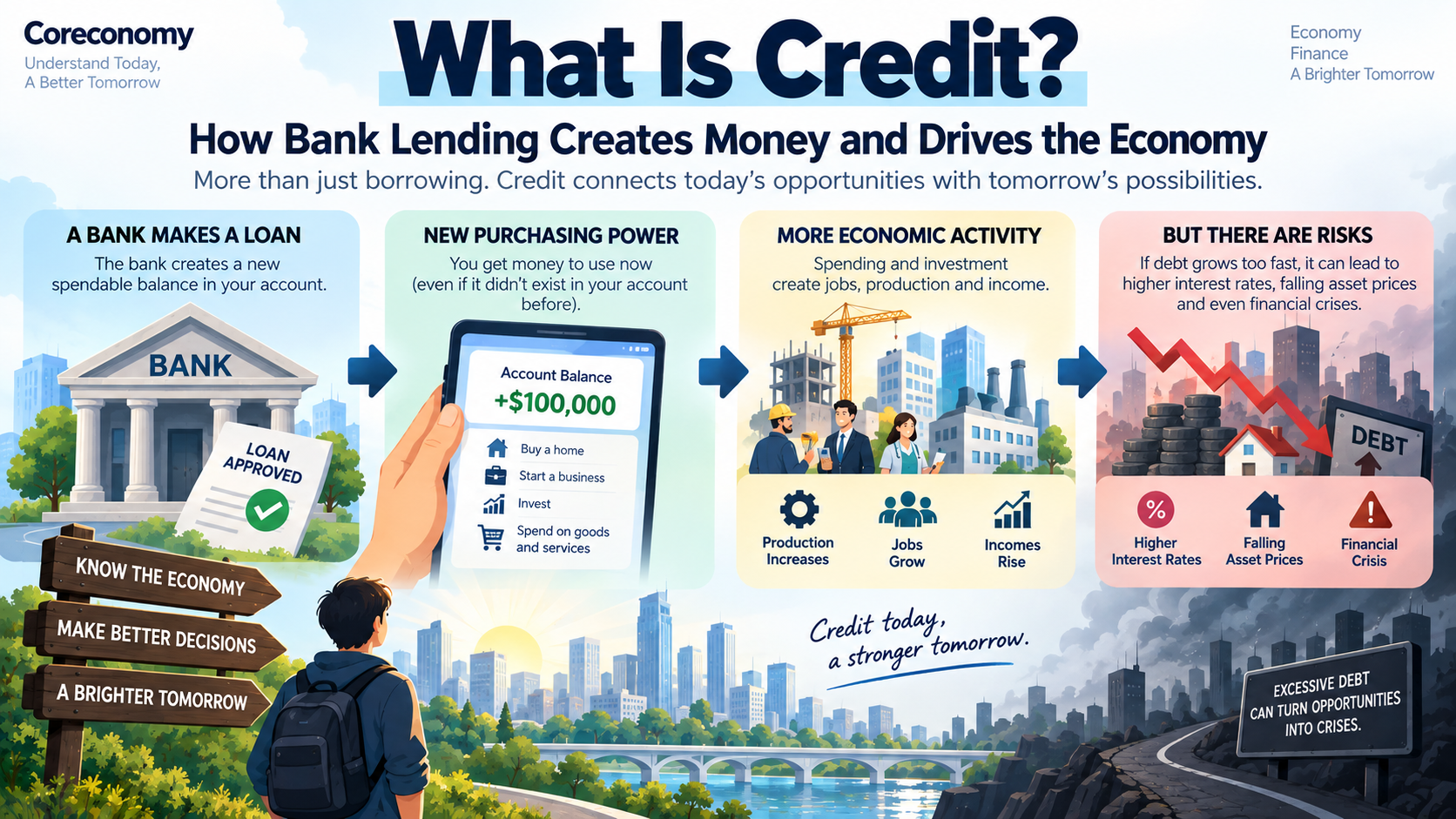
When you read economic or financial news, you often see the word credit.
But what does it actually mean?
You might naturally think:
“Does good credit just mean having a high credit score?”
Or:
“When a bank gives someone a loan, isn’t it simply lending money that somebody else deposited?”
And then an even stranger question appears:
“If a bank gives someone a loan, where does the money actually come from?”
You may also wonder:
“Why can more lending make the economy grow?”
“And why can a sudden decline in lending make the economy weaker?”
These questions are all connected.
Credit is more than simply borrowing money from a bank.
It is one of the mechanisms that allows households and businesses to spend, invest, and grow before they have earned all of the money needed to pay for those activities themselves.
But credit has another side:
More purchasing power today also means more repayment obligations in the future.
In this guide, we’ll start with the simplest idea of credit, then look at what actually happens when a bank makes a loan, why credit can expand an economy, why excessive credit can become dangerous, and how a credit contraction can contribute to a financial crisis.
1. What Is Credit?
In everyday language, credit usually means trust.
You trust someone because you believe they will keep a promise.
The same basic idea applies in economics.
In simple terms:
Credit is a financial relationship based on the expectation that money borrowed today will be repaid in the future.
Let’s use a simple example.
Imagine someone earns:
$3,000 per month
But they need:
$50,000 today
to buy a home, start a small business, or make another major investment.
They don’t have enough cash available right now.
So they borrow $50,000 from a bank.
Now two things happen at the same time:
Money available to use today ↑
and:
Money that must be repaid in the future ↑
That is the basic idea of credit.
A useful way to remember it is:
Credit connects today’s purchasing power with tomorrow’s repayment.
2. Why Are Credit and Debt Connected?
Let’s look at the same loan from both sides.
Suppose a bank lends someone:
$50,000
For the borrower, that is:
$50,000 of debt
The borrower has to repay the money according to the loan agreement, usually with interest.
For the bank, however, the same transaction creates:
A financial asset
The bank now has a claim on the borrower.
So the same loan creates:
A liability for the borrower
and:
An asset for the lender
This is important when thinking about the economy as a whole.
When debt increases, it does not simply mean that money has somehow disappeared.
It means that new financial claims and obligations have been created between economic participants.
3. What Actually Happens When a Bank Makes a Loan?
This is probably the most important part of the article.
Many people imagine the banking system like this:
People deposit money at banks
↓
Banks collect that money
↓
Banks lend some of it to other people
That explanation is easy to picture, but it does not fully explain how modern bank lending works.
Let’s look at a simple example instead.
Imagine someone receives a $100,000 bank loan.
Once the loan is approved and made available, the borrower’s bank account shows:
+$100,000 available to use
The borrower can now use that money to:
- Buy a house
- Buy a car
- Start a business
- Pay employees
- Purchase goods and services
- Transfer money to another person
The important point is that this $100,000 is not simply an existing pile of cash that was physically moved from another customer’s account to the borrower.
The bank has created a new balance in the borrower’s account as part of the lending process.
At the same time, the borrower has:
$100,000 of debt
So, in a very simplified way:
Purchasing power +$100,000
Debt +$100,000
are created together.
This is one of the most important ideas for understanding modern credit.
4. Does That Mean the Bank Just Creates “Free Money”?
Not exactly.
This is where the idea can become confusing.
You might think:
“Wait. Did the bank just create $100,000 out of nothing?”
In an economic sense, a new source of spendable purchasing power has been created through the loan.
But it is not free money.
The borrower also has a matching obligation:
The $100,000 must be repaid.
So the process is better understood as:
New purchasing power today
+
New repayment obligation tomorrow
The bank is not giving the borrower a gift.
The borrower has exchanged a future obligation for the ability to spend money today.
That is the essence of credit.
5. Then Why Do Economists Talk About “Deposits”?
This word can be confusing.
When most people hear deposit, they think of:
- A savings account
- A fixed-term deposit
- Money placed in a bank for a period of time
But in economics, bank deposit has a broader meaning.
It can refer to the money shown in a bank account that you can use for:
- Payments
- Transfers
- Purchases
- Withdrawals
So when a bank makes a loan, the borrower may see a new balance appear in their account.
In everyday language, you might simply think:
“The bank has put $100,000 into my account for me to use.”
Economists describe this as the creation of a bank deposit.
The important thing is not the vocabulary.
The important thing is understanding the process:
Bank loan
↓
New spendable balance
↓
More purchasing power
Once that idea is clear, the terminology becomes much easier.
6. Can Banks Create Unlimited Money?
No.
This is another common misunderstanding.
You might think:
“If banks can create purchasing power when they lend, why can’t they create unlimited amounts?”
Because banks face many constraints.
For example:
- They need customers who actually want to borrow.
- Borrowers need sufficient ability to repay.
- Banks must consider credit risk.
- Banks need sufficient capital.
- Banks need liquidity.
- Banks operate under financial regulations.
- Lending needs to make economic sense for the bank.
Imagine a bank looking at a potential borrower and thinking:
“This borrower is very unlikely to repay the loan.”
The bank may simply refuse to lend.
Now imagine an economy where households and businesses are already heavily indebted.
People may not want to borrow more, even if banks are willing to lend.
So:
Banks can create new bank deposits through lending
does not mean:
Banks can create unlimited money whenever they want.
Credit creation is constrained by both the demand for loans and the ability and willingness of banks to supply them.
7. How Can Credit Expand an Economy?
Now let’s look at the positive side of credit.
Imagine a small company wants to build a new factory.
The factory requires:
$10 million
The company does not currently have $10 million in cash.
But it believes the factory will generate enough future revenue to make the investment worthwhile.
So it borrows the money.
The chain might look like this:
Bank loan
↓
Factory construction
↓
Equipment purchases
↓
New employees
↓
More production
↓
More sales and income
The original loan has now become part of a much larger economic process.
This is one reason credit can help expand an economy.
It allows businesses and households to make productive investments before they have accumulated all of the money required to pay for them upfront.
8. Can Credit Make the Economy Look Bigger?
Yes—but this needs to be understood carefully.
Imagine an economy where households and businesses have very limited access to borrowing.
Investment may be limited by existing savings and cash.
Now imagine that credit becomes more available.
Businesses can:
- Build factories
- Buy equipment
- Hire workers
- Expand production
Households can:
- Buy homes
- Purchase durable goods
- Pay for education
- Start businesses
That additional spending can increase:
Production
Employment
Income
and:
Economic activity
So credit expansion can help make the current economic activity larger than it would otherwise be.
But there is an important condition:
The spending created by credit needs to be supported by future income and productive activity.
If credit simply creates more borrowing without creating enough income to support the debt, the benefits may not last.
9. Why Can Too Much Credit Become Dangerous?
Let’s imagine someone earns:
$50,000 per year
and has:
$100,000 of debt
That may or may not be manageable depending on the interest rate, assets, and cash flow.
Now imagine that over time:
Income → $55,000
Debt → $300,000
And later:
Income → $60,000
Debt → $500,000
Debt is growing much faster than income.
At first, this may not seem like a problem if:
- Interest rates are low
- Asset prices are rising
- Income is increasing
- Credit remains easy to obtain
But then imagine:
Interest rates rise
or:
Income falls
or:
Asset prices fall
Suddenly, the borrower may have much more difficulty making payments.
This is why the speed and quality of credit growth matter just as much as the amount of debt.
10. Why Can Credit and Asset Prices Move Together?
Let’s use housing as an example.
Imagine someone buys a:
$500,000 home
with:
$200,000 of their own money
and:
$300,000 borrowed from a bank
Now imagine the house rises in value:
$500,000 → $700,000
The owner’s equity has increased.
Other buyers may look at this and think:
“House prices keep going up.”
Banks may also see that the collateral is worth more.
In some circumstances, this can support additional borrowing.
A simplified chain might look like:
Higher asset prices
↓
Higher collateral values
↓
Greater borrowing capacity
↓
More demand
↓
Further asset-price increases
Real financial systems are much more complicated than this simple example.
Credit standards, regulations, income, interest rates, and investor expectations all matter.
But the important idea is:
Credit and asset prices can reinforce each other.
11. What Happens When Borrowers Repay Their Loans?
Now let’s look at the opposite direction.
Imagine the same borrower has:
$100,000 of bank debt
The loan was originally created to give the borrower additional purchasing power.
Now the borrower gradually repays the principal.
As the loan balance is paid down, the bank’s claim on the borrower becomes smaller.
At the same time, the bank-account balance associated with that lending can also shrink as the debt is repaid.
So, in simple terms:
More bank lending → more purchasing power can be created
while:
Loan repayment → that purchasing power can shrink
This is one of the key ideas behind:
Credit expansion
and:
Credit contraction
The important lesson is that credit can affect not only how much debt exists, but also how much purchasing power is circulating through the economy.
12. Why Can a Credit Contraction Hurt the Economy?
During a strong economic expansion, we can imagine a cycle like this:
More lending
↓
More consumption and investment
↓
Higher business revenue
↓
Higher income
↓
More borrowing and spending
But the cycle can also move in the opposite direction.
If banks become more cautious and borrowers become less willing or able to take on debt:
Less lending
↓
Less consumption and investment
↓
Lower business revenue
↓
Slower employment and income growth
↓
Less demand for new loans
This is why a sharp contraction in credit can become a much larger economic problem.
13. How Can a Credit Contraction Turn Into a Financial Crisis?
Now imagine that several groups become cautious at the same time.
Banks say:
“We need to reduce risk.”
Businesses say:
“We are worried about future sales.”
Households say:
“We already have too much debt.”
The result can be:
Less lending
↓
Less spending
↓
Less investment
↓
Lower business revenue
↓
Weaker income and employment
↓
More loan problems
↓
Even tighter lending
This can create a self-reinforcing cycle.
If the financial system is highly leveraged, the shock can spread from borrowers to banks, from banks to businesses, and from financial markets to the wider economy.
In severe cases, a credit contraction can become part of a broader financial crisis.
14. What Is a “Profitable but Broke” Business?
Here’s another important idea.
Imagine a company reports:
Sales: $1 million
and:
Costs: $700,000
The company appears to have:
$300,000 of profit
But what if most customers have not actually paid yet?
The company may have accounting profit but not enough cash available right now.
Meanwhile, the company still has to pay:
- Employees
- Rent
- Interest
- Taxes
- Suppliers
If it runs out of cash, it can face a serious financial problem even though its accounting statements show a profit.
This is one reason economists and investors distinguish between:
Profit
and:
Cash flow
A business can be profitable on paper and still have a liquidity problem.
15. What Can Central Banks Do When Credit Contracts?
If financial conditions become severely stressed, central banks can use several tools.
Depending on the situation, they may use:
- Lower policy rates
- Liquidity support
- Emergency financial-market measures
- Asset purchases
- Other forms of monetary easing
The purpose can be to reduce the risk of an uncontrolled contraction in lending and financial activity.
This is where credit connects to Quantitative Easing (QE).
For a deeper explanation of how QE can affect financial conditions and asset markets, see Understanding Quantitative Easing (QE).
16. How Does Credit Connect to the Long-Term Debt Cycle?
Now we can connect credit to the bigger picture we discussed in the previous article.
If credit expands for a long time:
More borrowing
↓
More spending and investment
↓
Higher incomes and asset prices
↓
Greater borrowing capacity
↓
More credit
This process can continue for years.
But if debt eventually grows much faster than income and repayment capacity:
Higher debt burden
↓
Greater sensitivity to interest rates
↓
Credit contraction
↓
Deleveraging
This is where credit becomes an important mechanism inside a long-term debt cycle.
For a broader look at this process, see Understanding the Long-Term Debt Cycle: Ray Dalio’s Perspective on Debt, Credit, and Economic Crises.
17. Four Things to Remember About Credit
You do not need to memorize every technical detail.
Start with these four ideas.
① Credit itself is not bad.
Credit can finance productive investment and help households and businesses bring future income into the present.
② Credit can increase today’s purchasing power.
A bank loan can create a new source of spendable funds in the borrower’s account.
③ More purchasing power also means more debt.
The borrower receives additional spending ability, but also takes on a future repayment obligation.
④ Credit can expand—and contract.
More lending can support spending and investment.
A major contraction in lending can weaken spending, asset prices, and economic activity.
Conclusion
Credit can seem like an abstract financial term.
But the basic idea is surprisingly simple:
Credit allows people and businesses to use purchasing power today based on the expectation of future repayment.
When a bank makes a loan:
New purchasing power can appear in the borrower’s account
while:
A matching repayment obligation is created.
That additional purchasing power can then be used for:
Consumption
or:
Investment
which can contribute to:
Production → Employment → Income
and economic growth.
But the same process creates debt.
If borrowing grows much faster than income and repayment capacity, the system can become vulnerable.
Then the direction can reverse:
Less lending → Less spending → Lower income → More credit problems → Tighter lending
In severe cases, that process can contribute to a financial crisis.
This is why credit is such an important part of economics.
It connects:
Interest Rates → Debt → Consumption → Investment → Asset Prices → Financial Crises → Economic Growth
The long-term debt cycle gives us the larger picture.
Credit helps us understand how that picture actually moves.
Once you understand that connection, financial news becomes much easier to read—not because every event becomes predictable, but because you can finally see the economic mechanism underneath the headlines.