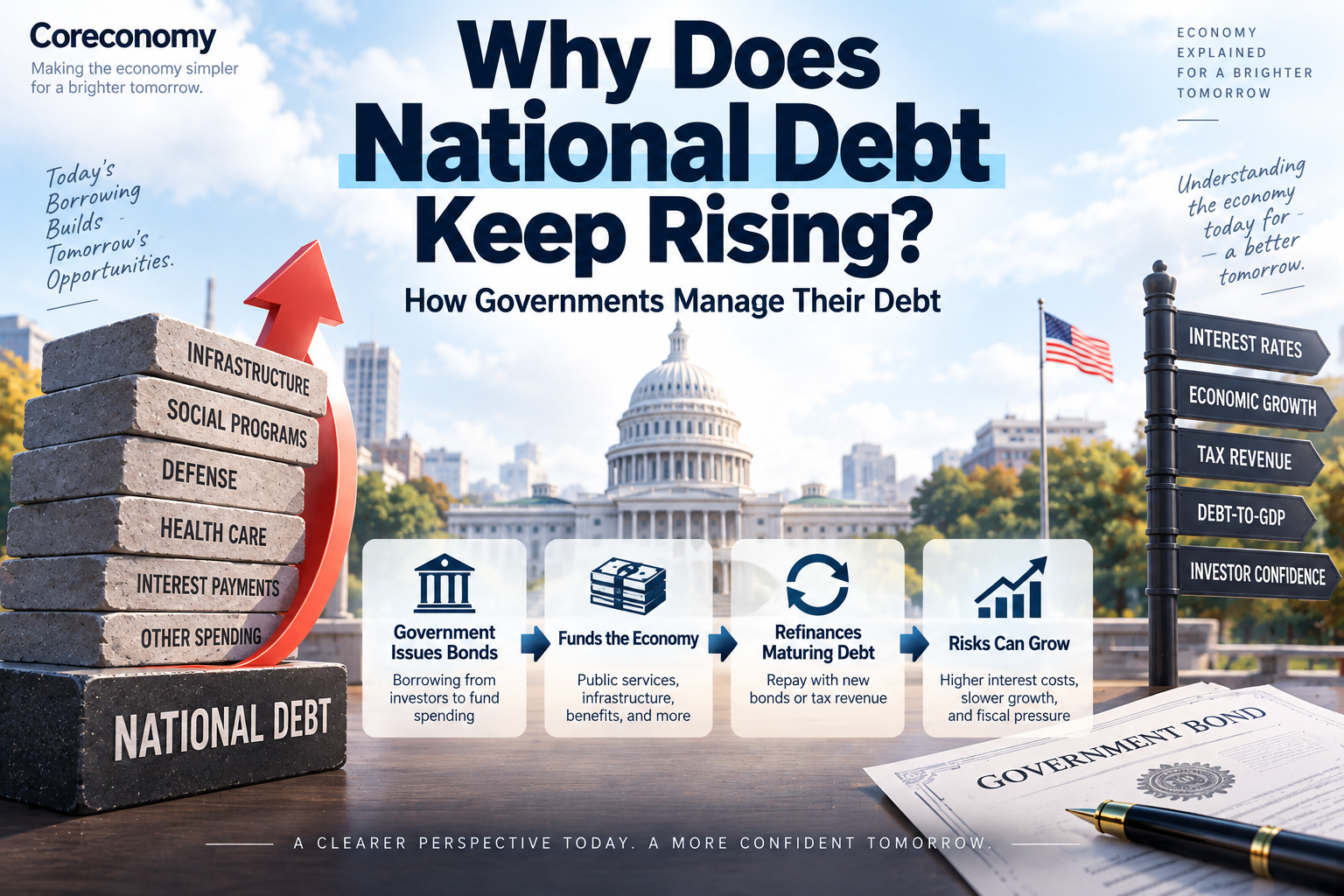
When you read economic news, you often see headlines like:
“National debt reaches a record high.”
“Government borrowing continues to rise.”
“Debt-service costs are putting pressure on the budget.”
For someone new to economics, this can raise a very simple question:
“If a person borrows money, they eventually have to pay it back. Why can a government keep carrying debt for decades?”
You may also wonder:
“Does a country eventually have to pay off all of its debt?”
“What happens when government bonds mature?”
“Can a government simply borrow more money to repay old debt?”
These questions become much easier once you understand how government debt actually works.
The key idea is:
Government debt is not simply about how much money a country owes. It is about whether the government can continue to manage its debt burden over time.
This guide explains the difference between personal debt and government debt, how government bonds work, why governments refinance maturing debt, and what can make public debt dangerous.
1. Why Is Government Debt Different From Personal Debt?
Let’s start with an individual.
Imagine someone borrows:
$50,000
from a bank.
The borrower is expected to repay:
Principal + interest
over time.
If the borrower cannot make the payments and cannot find another way to meet the obligation, problems can eventually lead to:
Missed payments
→ Default
→ Legal action
→ Bankruptcy
Governments face debt obligations too.
But governments have tools that individuals do not.
For example, a government may:
- Collect taxes
- Adjust spending
- Issue government bonds
- Manage the maturity of its debt
- In some monetary systems, operate alongside a central bank that issues the country’s currency
But there is an important qualification:
Not every government can simply create unlimited amounts of money.
Before looking deeper into government debt, it helps to understand how credit and borrowing actually work in the economy. See What Is Credit? for a simple explanation.
A government that issues its own currency has a different set of options from a government that borrows heavily in a foreign currency.
Countries that share a currency can also face different constraints from countries with fully independent monetary systems.
So when thinking about government debt, one of the first questions should be:
What monetary system does this government operate under?
2. Does a Government Have to Reduce Its Debt to Zero?
Not necessarily.
Think about a person who takes out a mortgage.
The usual goal is eventually:
Debt → $0
But governments operate continuously.
Every year, governments:
- Collect taxes
- Fund public services
- Build infrastructure
- Pay pensions and other benefits
- Fund defense
- Respond to recessions or emergencies
Government finances therefore do not have a natural “end date.”
Government bonds are one of the tools governments use to finance those activities over time.
So the existence of government debt is not unusual.
The more important question is:
Can the government continue to service and manage that debt?
That is a much better question than simply asking:
“Does the government have debt?”
3. What Does It Mean When a Government Issues Bonds?
Imagine a government collects:
$100 billion in revenue
but plans to spend:
$120 billion
The government has a:
$20 billion budget deficit
It needs to find a way to finance that gap.
One common method is to issue government bonds.
The government effectively says:
“We will borrow money from investors and repay them according to the terms of the bond.”
Investors provide the money.
In return, the government promises:
Interest payments + repayment of principal
So a government bond is essentially:
A financial claim held by an investor and a liability owed by the government.
From the government’s perspective:
Bond = debt
From the investor’s perspective:
Bond = financial asset
4. What Happens When a Government Bond Matures?
This is one of the most important questions.
Imagine a government issued:
$10 billion of 10-year bonds
Ten years later, the bonds mature.
Does the government have to keep exactly $10 billion in cash somewhere for ten years and hand it back?
Not necessarily.
The government can repay the debt using:
Tax revenue
or it can raise new funds by:
Issuing new government bonds
and use those funds to repay the maturing bonds.
This is called:
Refinancing
A simplified example looks like this:
Existing $10 billion bond matures
↓
Government issues a new $10 billion bond
↓
New borrowing is used to repay the old bond
This is a normal part of government debt management.
It does not automatically mean the government is in financial trouble.
5. So Can Governments Borrow Forever?
Not without limits.
Refinancing only works if investors are willing to continue lending to the government.
And investors will ask:
“Will this government still be able to manage its debt in the future?”
If investors remain confident, government bonds may continue to attract buyers.
But if confidence falls, investors may demand:
Higher interest rates
to compensate for the additional risk they perceive.
That creates a problem.
Suppose a government used to refinance debt at:
2%
but now has to refinance at:
5%
The debt principal may be unchanged.
But the cost of servicing new debt can become much higher.
So refinancing itself is not the problem.
The real question is:
Can the government afford the cost of refinancing?
6. When Does Government Debt Become Dangerous?
A large amount of debt does not automatically mean a government is in crisis.
Consider two governments that both have:
$500 billion of debt
Suppose each has a GDP of:
$1 trillion
Their debt-to-GDP ratio is:
50%
So far, they look identical.
But now imagine:
Government A
Average borrowing cost:
2%
Government B
Average borrowing cost:
8%
If we use a simplified calculation:
Government A:
$500 billion × 2%
= $10 billion
Government B:
$500 billion × 8%
= $40 billion
The amount of debt is identical.
But the interest burden is four times larger for Government B.
This is why debt levels alone do not tell the whole story.
7. What Should We Look at Besides Debt?
To understand whether government debt is manageable, look at several variables together.
① Debt level
How much has the government borrowed?
② Economic size
How large is the debt relative to GDP?
③ Interest costs
How expensive is it to service the debt?
④ Economic growth
How quickly are the economy and government revenues growing?
⑤ Debt maturity
When do the bonds mature?
Are large amounts coming due at the same time?
⑥ Currency
Is the government borrowing in its own currency or a foreign currency?
These factors can produce very different outcomes even when two countries have similar debt ratios.
8. Why Does the Currency of the Debt Matter?
Let’s compare two hypothetical governments.
Government A
Borrowed:
100 billion units of its own currency
Government B
Borrowed:
100 billion U.S. dollars
Now imagine the local currency of Government B falls sharply.
The government still owes:
$100 billion
But that debt may now require far more local currency to service.
This is one reason foreign-currency debt can create additional vulnerability.
Government A, by contrast, has debt denominated in the currency it controls domestically, although that does not mean its debt is automatically risk-free.
The government may still face:
- Inflation
- Higher interest rates
- Loss of investor confidence
- Currency depreciation
- Fiscal constraints
So:
Debt currency matters.
9. Government Bonds Are More Than Just “Government Debt”
From the government’s perspective, a bond is a liability.
But from an investor’s perspective, it is an asset.
For example:
Government issues $10 billion of bonds
The government’s balance sheet shows:
Liability +$10 billion
Investors who purchase those bonds now hold:
Financial assets worth $10 billion
Government bonds can therefore play a major role in the financial system.
Banks, pension funds, insurance companies, investment funds, and individual investors can all hold government bonds.
This is why government debt is not just a number on a government balance sheet.
It is also part of the broader financial system.
10. Are Government Bonds Completely Risk-Free?
Not necessarily.
You may often hear:
“Government bonds are safe.”
That is too broad.
Different government bonds face different types of risk.
These can include:
- Default risk
- Interest-rate risk
- Inflation risk
- Currency risk
For example, even if a government does not default on a long-term bond, the bond’s market price can fall significantly when market interest rates rise.
To understand why rising market interest rates can push existing bond prices lower, see Understanding Interest Rates and Bonds.
This connects directly to something we discussed earlier:
Bond prices and market yields generally move in opposite directions.
So:
Government bond ≠ risk-free under every circumstance.
Government bonds are important financial assets, but the type and nature of the risk still matter.
11. Would Financial Markets Collapse if Governments Had No Debt?
Not necessarily.
Government bonds can serve important roles in financial markets.
They may be used as:
- Investment assets
- Collateral
- Liquidity instruments
- Reference points for pricing other financial assets
So a major change in the supply of government bonds could affect:
Bond markets
Financial institutions
Collateral markets
Liquidity
Asset allocation
But it would be incorrect to say:
“If governments completely paid off their debt, the financial system would automatically collapse.”
Financial systems contain many other assets and funding mechanisms.
The more accurate statement is:
Government bonds play important roles in financial markets, so major changes in their supply can affect how the financial system operates.
That distinction matters.
12. Why Does Government Debt Keep Rising?
One of the simplest reasons is:
Persistent budget deficits.
Imagine:
Year 1
Revenue:
$100
Spending:
$110
Deficit:
$10
Year 2
Revenue:
$105
Spending:
$115
Deficit:
$10
Year 3
Revenue:
$110
Spending:
$125
Deficit:
$15
If deficits continue, government debt can continue to rise.
And governments can face additional spending pressures from:
- Recessions
- Natural disasters
- Military conflicts
- Aging populations
- Infrastructure needs
- Social programs
- Emergency economic support
This is why government debt can continue increasing for many years.
13. Does Rising Debt Always Mean a Country Is Becoming Less Healthy?
Not necessarily.
This is one of the most important points for beginners.
Suppose:
GDP = $1 trillion
Debt = $500 billion
Debt-to-GDP:
50%
Now suppose several years later:
GDP = $1.3 trillion
Debt = $550 billion
Debt has increased by $50 billion.
But:
$550 billion ÷ $1.3 trillion ≈ 42%
The debt-to-GDP ratio has actually fallen.
So:
Debt can increase while the debt burden relative to the economy decreases.
This is why economists often look at debt relative to GDP rather than the absolute number alone.
14. What Combination Makes Government Debt More Dangerous?
The most difficult situation is often a combination of several problems:
Debt ↑↑
Economic growth ↓
Interest rates ↑
Government revenue growth ↓
Here’s the potential chain:
Higher debt
↓
Higher interest costs
↓
Less fiscal room
↓
Pressure to raise taxes or cut spending
↓
Potentially weaker economic growth
This does not mean a crisis is guaranteed.
But it means the government’s room for error can become much smaller.
The important point is:
Debt becomes more difficult when the ability to service it grows more slowly than the cost of carrying it.
15. Is There a Universal “Safe” Debt Ratio?
There is no single number that works for every country.
It is tempting to say:
“Debt below X% of GDP is safe.”
But countries differ in:
- Economic growth
- Interest rates
- Tax systems
- Currency systems
- Financial-market size
- Demographics
- Foreign-currency debt
- Investor confidence
One country may sustain a relatively high debt ratio while borrowing at low rates.
Another country may experience market pressure at a much lower debt ratio.
So:
Debt-to-GDP is useful, but it is not a magic safety line.
You need to look at the broader financial picture.
16. What Is the Simplest Way to Understand Government Debt?
Let’s put the entire process together.
A government gets money mainly through:
Taxes + Borrowing
It uses that money for:
Public services + Investment + Transfers + Defense + Interest payments
When tax revenue is not enough:
New bonds may be issued
When old bonds mature:
The government may repay them or refinance them
For this system to remain manageable, several things matter:
Economic growth
Government revenue
Interest costs
Investor demand
Debt maturity
Currency structure
If debt grows too quickly while growth weakens and interest costs rise, the system becomes much harder to manage.
17. Let’s Compare Government Debt With Personal Debt One More Time
Now we can return to our original question:
“Why can’t a government just pay off its debt like an individual?”
An individual usually has:
Income → Living expenses → Debt repayment
A government operates within a much larger system:
Tax revenue
+
Government spending
+
Bond issuance
+
Refinancing
+
Economic growth
Governments can therefore continue to carry debt for long periods.
But that does not mean governments have unlimited borrowing power.
They still face:
Interest costs + Economic growth + Government revenue + Investor confidence
These are the real constraints.
18. When Should You Start Worrying About Government Debt?
For a beginner, remember these four questions.
① Is debt growing faster than the economy?
② Are interest costs taking up an increasing share of government revenue?
③ Can the government continue refinancing maturing debt at reasonable rates?
④ Is the government exposed to large interest-rate or currency shocks?
These questions are much more useful than simply asking:
“How large is the national debt?”
19. What Comes Next?
Now we can ask the natural next question:
“If a government already has a large debt burden, what can it actually do about it?”
Possible approaches include:
- Economic growth
- Fiscal consolidation
- Interest-rate policy
- Debt maturity management
- Inflation
- Debt restructuring
But every option comes with costs and trade-offs.
That is the subject of the next article:
Conclusion
When people first hear about government debt, the instinctive question is:
“If the country borrowed the money, shouldn’t it simply pay everything back?”
The reality is more complicated.
Governments can finance spending through taxation and borrowing, and they can refinance maturing debt by issuing new bonds.
So the existence of government debt is not automatically a crisis.
What matters is whether the government can continue to manage:
Debt + Interest Costs + Economic Growth + Government Revenue + Investor Confidence
over time.
This is why a country can have rising debt without immediately facing a crisis.
At the same time, rising debt can become dangerous when:
Debt grows rapidly
Economic growth weakens
Interest rates rise
Government revenues struggle to keep up
The most useful question is therefore not:
“How much debt does the country have?”
but:
“Can the country continue to carry and refinance that debt without creating an unsustainable burden?”
Once you begin looking at debt this way, headlines about government borrowing become much easier to understand.
And that leads naturally to the next question:
What can governments and central banks actually do when debt becomes too large?