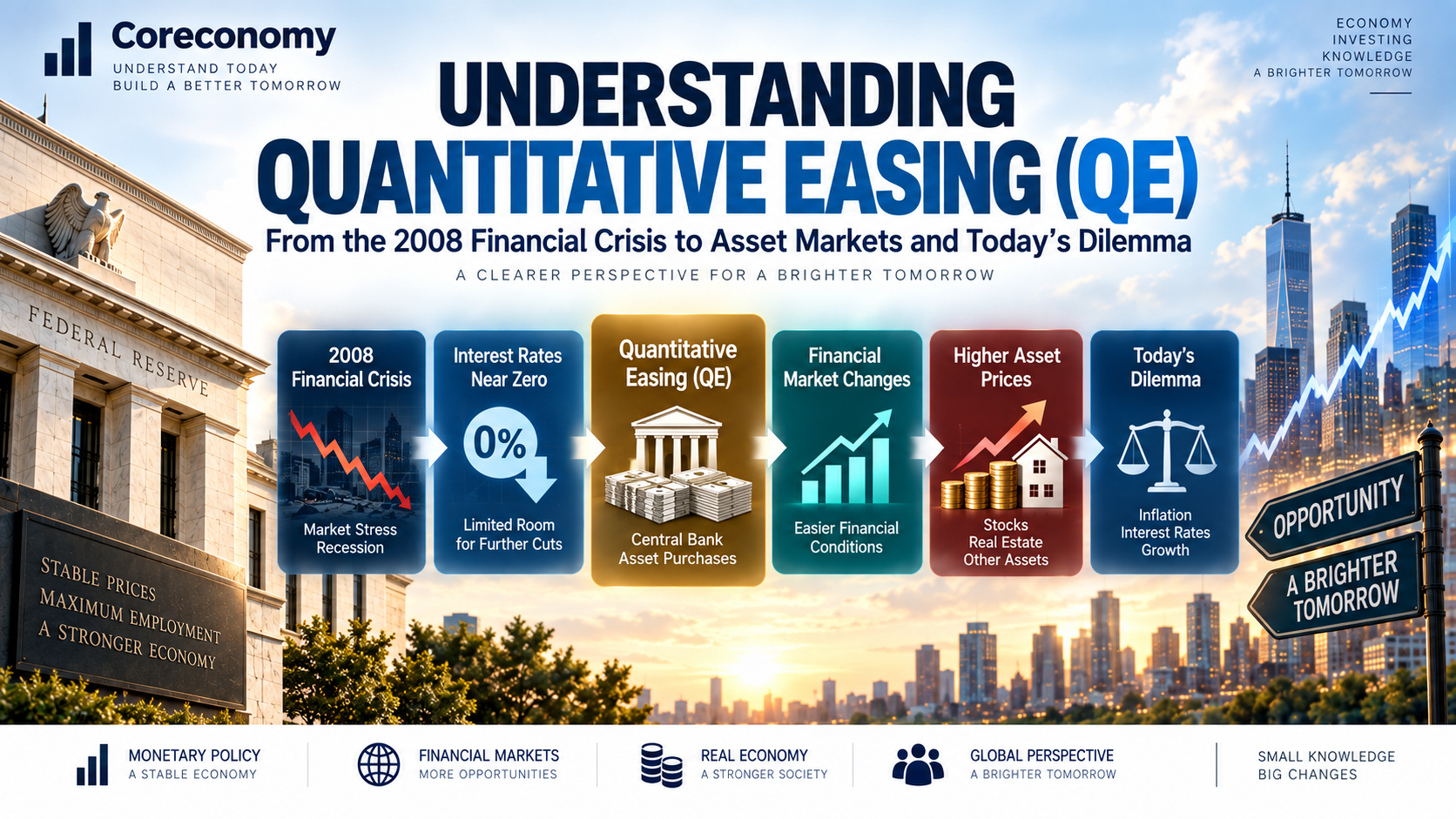
When you read financial news, you will often come across the term Quantitative Easing, or QE.
At first, QE can sound confusing.
You may wonder:
“What does it mean when a central bank ‘injects money’ into the economy?”
“Why can buying bonds affect stock prices?”
“Does QE automatically create inflation?”
“And why would a central bank later try to reduce its balance sheet?”
These questions are closely connected.
A useful way to understand QE is to follow the chain:
2008 Financial Crisis → Rate Cuts → Limits of Conventional Policy → Quantitative Easing → Financial Conditions → Asset Markets → Inflation and Tightening → Quantitative Tightening
In this guide, we will look at why QE was introduced, how it works, how it can affect financial markets, what its potential side effects are, and why central banks may later reverse course.
1. Where It All Began: The 2008 Financial Crisis
To understand QE, we first need to understand the financial crisis of 2008.
The crisis began with severe problems in the U.S. housing and financial markets.
A simplified version of the chain looks like this:
Housing market stress
↓
Falling values of mortgage-related assets
↓
Large losses for financial institutions
↓
Financial-market stress and tighter credit
↓
Weaker borrowing conditions for households and businesses
↓
Lower consumption and investment
↓
Economic recession
Under normal conditions, financial institutions lend money, investors buy and sell securities, and capital flows through the economy.
But during a severe financial crisis, even institutions with access to funding may become reluctant to lend because they are uncertain about the financial health of other institutions.
The financial system can therefore experience a credit and liquidity shock.
The Federal Reserve responded by cutting its policy rate aggressively. By the end of 2008, the federal funds target range had fallen to 0–0.25%. As the crisis continued, the Fed turned to large-scale asset purchases as an additional policy tool. (federalreserve.gov)
2. What If Interest Rates Are Already Near Zero?
Imagine a central bank trying to support a weak economy.
It might reduce interest rates:
5%
↓
3%
↓
1%
↓
0.25%
Lower interest rates can reduce borrowing costs and make financial conditions easier.
But what happens when rates are already close to zero?
There is much less room to stimulate the economy through traditional short-term interest-rate policy alone.
This creates a problem:
“If the usual interest-rate tool is becoming less effective, what else can the central bank do?”
One answer is Quantitative Easing (QE).
3. What Is Quantitative Easing?
Quantitative Easing, or QE, is a monetary-policy tool in which a central bank makes large-scale purchases of financial assets, such as government bonds and, in some programs, mortgage-backed securities.
A simple definition is:
QE is a policy in which a central bank purchases large amounts of financial assets in an effort to influence longer-term interest rates and broader financial conditions.
This is where beginners often get confused.
QE does not simply mean:
“The central bank gives free cash directly to ordinary people.”
And it is also not best understood as:
“The central bank gives banks a pile of money so they can buy stocks.”
The key mechanism is asset purchases.
During the 2008 financial crisis, the Federal Reserve purchased agency debt and mortgage-backed securities and later expanded its purchases to longer-term Treasury securities. These programs were intended to improve financial conditions and support credit markets and the broader economy.
Source: Federal Reserve — Large-Scale Asset Purchases
4. So What Actually Happens When the Central Bank Buys Bonds?
Let’s use a simple example.
Suppose an investor owns $10 million worth of long-term government bonds.
A central bank enters the market and buys some of those bonds.
The transaction looks roughly like this:
Investor → sells bonds to the central bank
Central bank → pays the investor
The investor now holds fewer bonds and more cash or bank deposits.
The central bank, meanwhile, now holds more bonds.
This means the composition of assets held by the private sector changes.
A useful way to think about QE is therefore:
Central-bank asset purchases
↓
Changes in the assets held by the private sector
↓
Changes in asset prices and yields
↓
Changes in broader financial conditions
This is more accurate than simply saying that the central bank “prints money and throws it into the economy.”
5. Why Can Buying Bonds Push Interest Rates Lower?
This is where QE connects to something we discussed in the previous article.
For an existing fixed-rate bond, bond prices and market yields generally move in opposite directions.
Suppose a central bank buys a large amount of long-term bonds.
The increase in demand can put upward pressure on bond prices.
And when bond prices rise, their market yields tend to fall.
The basic chain can therefore look like this:
Central-bank bond purchases
↓
Higher demand for bonds
↓
Higher bond prices
↓
Lower yields
The Federal Reserve has described large-scale asset purchases as a way to put downward pressure on longer-term interest rates and ease broader financial conditions. (federalreserve.gov)
This is also why understanding the relationship between bond prices and yields is important when learning about QE.
6. How Can QE Affect the Stock Market?
Now we can connect QE to stocks.
Imagine an investor who is comfortable holding:
U.S. Treasury bonds → relatively low risk + a certain yield
But suppose large-scale asset purchases contribute to lower yields on safe assets.
The investor may start asking:
“If the return available from safer bonds has fallen, are there other assets worth considering?”
Some investors may then rebalance their portfolios toward assets such as:
- Corporate bonds
- Stocks
- Real estate
- Other riskier investments
This is often discussed through the portfolio balance channel or portfolio rebalancing.
The Federal Reserve has described how large-scale asset purchases can change the supply of assets available to private investors, encouraging portfolio adjustments that may affect the prices and yields of other financial assets as well.
Source: Federal Reserve — Monetary Policy Report
7. A Simple Example
Let’s make this easier to visualize.
Situation A
Suppose a 10-year government bond offers a yield of:
5%
An investor may think:
“A relatively safe asset is already giving me a reasonable return.”
That may reduce the need to take on additional risk.
Situation B
Now imagine that the yield falls to:
2%
The investor may think:
“The return from safe bonds is much lower than before.”
Some investors may respond by shifting part of their portfolio toward:
Corporate bonds
Stocks
Real estate
Other investments
This is one possible way QE and easier financial conditions can influence asset markets.
The important point is:
QE does not automatically make stock prices rise.
Instead, it can change financial conditions and investors’ incentives, which can contribute to changes in asset prices.
Stock prices are still influenced by:
- Corporate earnings
- Economic growth
- Valuation
- Risk appetite
- Interest rates
- Expectations about the future
8. Did QE Create Asset Bubbles?
This is where the economic debate becomes more complicated.
After major rounds of QE, many financial assets experienced significant price increases.
That has led some observers to argue:
“QE created asset bubbles.”
But it would be too simplistic to treat that as an established one-to-one relationship.
Asset prices are affected by many factors, including:
- Corporate earnings
- Economic growth
- Interest rates
- Investor expectations
- Fiscal policy
- Global capital flows
- Risk appetite
A more careful conclusion is:
QE can contribute to easier financial conditions and create channels through which asset prices may rise, but the size and persistence of any asset-price increase depend on many other factors as well.
This distinction is important.
9. Did QE Increase Wealth Inequality?
Another major debate concerns inequality.
Imagine two households:
Household A
Owns:
$1 million in stocks and real estate
Household B
Owns:
Mainly cash and bank deposits
Now suppose financial assets rise sharply.
Household A may see a significant increase in the market value of its assets.
Household B may experience a much smaller direct benefit.
This is one reason economists and policymakers have debated whether monetary easing can contribute to differences in wealth outcomes.
But again, it would be too strong to conclude:
“QE caused wealth inequality.”
Wealth inequality is also shaped by:
- Housing policy
- Tax policy
- Wage growth
- Education
- Labor-market conditions
- Technology
- Business ownership
QE can be part of the discussion, but it is not the only explanation.
10. Was QE a Failure?
It would also be too simple to call QE either a complete success or a complete failure.
Think about the environment in 2008.
The economy was facing:
Financial-system stress
+
Tight credit
+
Recession risk
+
Rising unemployment risk
The purpose of QE was not to create permanently high asset prices.
The goal was to support financial markets, improve credit conditions, reduce longer-term interest rates, and help prevent an even deeper economic downturn.
The Federal Reserve’s crisis-era asset purchases were part of a broader effort to stabilize mortgage and credit markets and support the recovery. (federalreserve.gov)
When evaluating a policy like QE, it is therefore useful to ask two questions:
What were the benefits?
and:
What were the costs and side effects?
That is a more useful way to evaluate economic policy than simply labeling it “good” or “bad.”
11. What Happened During the COVID-19 Crisis?
QE was not used only during the 2008 financial crisis.
When the COVID-19 shock hit in 2020, the Federal Reserve again used large-scale asset purchases alongside other policy measures.
At that time, the economy faced an extremely sharp contraction and financial-market stress.
The Federal Reserve purchased large quantities of Treasury securities and agency mortgage-backed securities to support market functioning and broader financial conditions. (federalreserve.gov)
But the economic environment after 2020 was different from 2008.
The initial shock was followed by:
Strong demand recovery
+
Supply-chain disruptions
+
Labor-market changes
+
Energy and commodity shocks
As demand recovered while supply remained constrained, inflation became a major problem.
This eventually pushed central banks toward a different policy direction:
Easing → Tightening
12. From QE to QT: Why Shrink the Balance Sheet?
This leads us to another term:
QT — Quantitative Tightening
A simple way to think about the difference is:
QE → central-bank assets increase
while:
QT → central-bank assets decrease
For example, if a bond held by a central bank matures and the central bank does not reinvest the principal into another security, its holdings can gradually decline.
Central banks can therefore reduce the size of their balance sheets without necessarily selling every asset directly into the market.
As the central bank reduces its holdings, the amount and composition of securities held by the private sector can change, which may affect longer-term interest rates and broader financial conditions. The Federal Reserve has discussed these effects in its analysis of balance-sheet reduction.
Source: Federal Reserve — A Decomposition of Balance Sheet Reduction
13. QE and QT at a Glance
| QE | QT | |
|---|---|---|
| Full Name | Quantitative Easing | Quantitative Tightening |
| Central-bank balance sheet | Expands | Contracts |
| Main action | Large-scale asset purchases | Reduction of asset holdings |
| Financial conditions | Tends toward easing | Tends toward tightening |
| Typical purpose | Support markets and the economy | Reduce monetary accommodation |
| Possible market effect | Lower long-term yields | Upward pressure on long-term yields |
These are broad tendencies, not mechanical rules.
The actual market response depends on the broader economic environment.
14. What Is the Relationship Between QE and Inflation?
This may be the most misunderstood part of QE.
A common simplified formula is:
QE → More Money → Inflation
But reality is more complicated.
QE can ease financial conditions.
Easier financial conditions can affect:
- Borrowing
- Consumption
- Investment
- Asset prices
- Economic expectations
If demand then grows faster than the economy’s productive capacity, inflationary pressure can increase.
But inflation also depends on:
- Supply conditions
- Energy prices
- Wages
- Productivity
- Fiscal policy
- Inflation expectations
- Global economic conditions
So the more accurate conclusion is:
QE can contribute to inflation through several economic channels, but QE and inflation should not be treated as a one-to-one relationship.
To understand the broader relationship between inflation, economic activity, and financial conditions, see Inflation, Deflation, and Stagflation Explained.
15. Is QE Good or Bad for the Economy?
There is no universal answer.
During a severe financial crisis, QE may help prevent financial conditions from tightening even further and may support economic recovery.
But if financial conditions remain extremely loose for too long while the economy is already recovering strongly, policymakers may have to consider inflation and other side effects.
Every policy has trade-offs.
That is why the most useful question is not:
“Is QE good or bad?”
but rather:
“Why was QE used, under what economic conditions, and what were its benefits and costs?”
16. What Can We Learn From QE?
The history of QE shows that central banks have more tools than simply changing short-term interest rates.
Depending on circumstances, policymakers can use:
- Policy-rate changes
- Asset purchases
- Liquidity facilities
- Forward guidance
- Balance-sheet reduction
These tools can affect financial markets through different channels.
A useful way to connect the ideas is:
Central-bank policy
↓
Bond markets and interest rates
↓
Stock and real-estate markets
↓
Exchange rates and financial conditions
↓
Consumption and investment
QE therefore matters not because it is a strange technical policy from 2008, but because it provides a useful way to understand how monetary policy can spread through the financial system.
17. Why Does QE Still Matter Today?
Once you understand QE, financial headlines become easier to read.
Suppose you see:
“The central bank expanded its bond purchases.”
You can immediately ask:
How might this affect long-term yields?
Or suppose you read:
“The central bank is reducing its balance sheet.”
You can ask:
What might happen to the supply of bonds and overall financial conditions?
And if you see:
“Interest rates have fallen.”
You can connect the dots:
Bonds → Yields → Stocks → Real Estate → Exchange Rates
This is the real value of learning macroeconomics.
The goal is not simply to memorize terms.
It is to understand how one economic change can spread through the rest of the financial system.
To see how changes in financial conditions can appear in actual stock-price movements, see How to Read Stock Charts.
Conclusion
Quantitative easing is often described simply as:
“The central bank printing money.”
That description is easy to remember, but it is too simple.
A more accurate explanation is:
QE is a monetary-policy tool in which a central bank makes large-scale purchases of financial assets to influence longer-term interest rates and broader financial conditions.
The chain can be summarized as:
Central-bank asset purchases
↓
Changes in bond prices and yields
↓
Easier financial conditions
↓
Portfolio adjustments by investors
↓
Potential effects on stocks, corporate bonds, and real estate
↓
Spillovers into consumption and investment
But the outcome is never determined by QE alone.
The economic environment, corporate earnings, inflation, fiscal policy, investor expectations, and global financial conditions all matter.
And once QE is no longer needed, the story can move in the opposite direction:
QE → QT
Understanding this cycle makes it much easier to connect financial-market headlines to the larger macroeconomic picture.