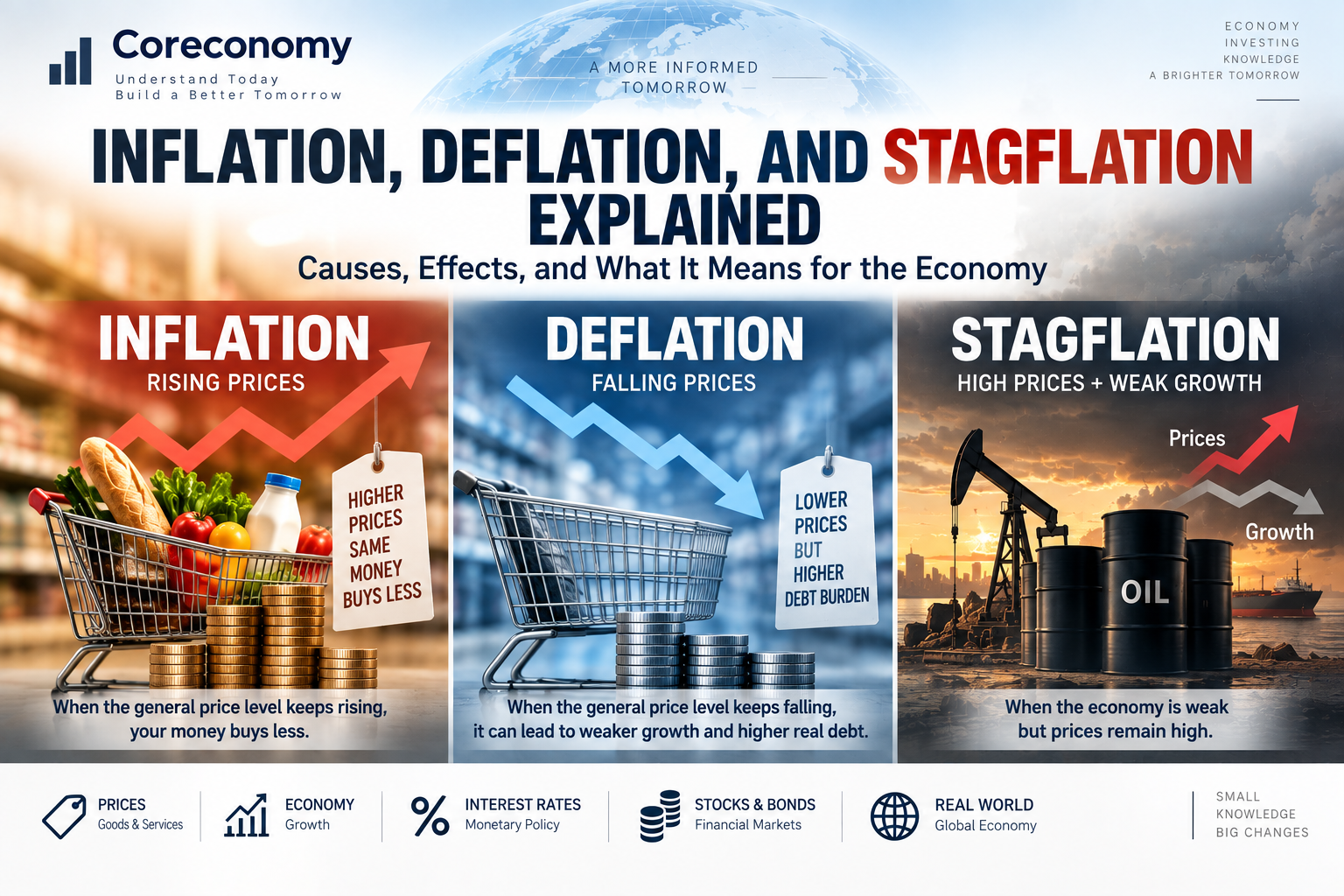
When you read economic news, you often come across words like inflation, deflation, and stagflation.
They may sound complicated at first.
You might naturally think:
“Does inflation simply mean that things at the supermarket are getting more expensive?”
“Is deflation just the opposite?”
“And is stagflation simply a period of very high inflation?”
These ideas are related, but they are not quite that simple.
In this guide, we’ll start with the meaning of prices and the overall price level, then move through inflation, deflation, and stagflation step by step.
We will also look at how these conditions can affect households, financial markets, and economic policy, and finally connect the concepts to the economic environment in 2026.
1. First, What Does “The Price Level” Mean?
To understand inflation, we first need to understand the price level.
In simple terms, the price level refers to the general level of prices for goods and services across an economy.
This is where beginners often get confused.
You might think:
“So if prices go up at the supermarket, that’s inflation, right?”
Sometimes, but not necessarily.
Imagine that only the price of apples rises:
- Apples: $5 → $6
- Milk: unchanged
- Rice: unchanged
- Bus fares: unchanged
- Mobile phone bills: unchanged
In that case, we would normally say the price of apples has increased.
Inflation is broader.
It refers to a sustained increase in the general price level across the economy, rather than a temporary increase in the price of one particular product.
Economists use measures such as consumer price indexes to track changes in the prices of a broad basket of goods and services.
An Easy Example
Imagine a household spends about $2,000 per month:
- Food: $500
- Housing: $1,000
- Transportation: $200
- Communications: $100
- Education, healthcare, and other expenses: $200
Now suppose that, several years later, maintaining a similar standard of living requires $2,200.
The price of every item does not have to rise by exactly 10%.
Some prices may rise significantly, some may barely change, and some may even fall.
But if the overall level of prices rises persistently, that is the basic idea behind inflation.
2. What Is Inflation?
Inflation is a sustained increase in the general price level of goods and services in an economy.
A simple way to think about it is:
The same amount of money buys fewer goods and services than before.
A Simple Example
Suppose $10 used to buy:
- Two sandwiches
- One coffee
- One snack
Later, you need $12 to buy roughly the same combination of goods.
The purchasing power of your $10 has declined.
This is one of the most important ways inflation is experienced in everyday life.
However, inflation does not mean every price rises at the same rate.
Some prices may rise quickly.
Others may barely change.
Some may even decline.
What matters is the broader and persistent movement in the overall price level.
3. Why Does Inflation Happen?
It is common to hear:
“Inflation happens because too much money has been printed.”
That can be part of the story in some circumstances, but it is not a complete definition or explanation.
Inflation can arise from several different forces.
A useful starting point is to distinguish between demand-side and supply-side pressures.
① When Demand Becomes Too Strong
Imagine that consumers and businesses suddenly start spending much more than usual.
For example:
- Consumers buy more cars
- Businesses increase investment
- Government spending increases
If overall demand grows faster than the economy’s ability to produce goods and services, businesses may gain more pricing power.
In simple terms:
Too many buyers are competing for limited goods and services.
This is often referred to as demand-pull inflation.
② When Production Costs Rise
Inflation can also occur even when demand is not exceptionally strong.
Imagine that:
- Oil prices rise
- Natural gas prices rise
- Grain prices rise
- Shipping costs rise
- Labor costs rise
Businesses now face higher production costs.
If they cannot absorb those costs indefinitely, they may raise the prices of their products and services.
For example:
Higher wheat prices
↓
Higher costs for a bakery
↓
Higher production costs
↓
Higher bread prices
This is commonly described as cost-push inflation.
③ Money and Credit Conditions Can Also Matter
Easier financial conditions can encourage borrowing, consumption, and investment.
When money and credit expand rapidly relative to the economy’s ability to produce goods and services, inflationary pressure can increase.
But this should not be reduced to:
More money = automatic inflation
The outcome depends on many factors, including economic capacity, demand, productivity, expectations, and supply conditions.
4. What Does Inflation Feel Like in Everyday Life?
This is probably the most important question for someone learning economics.
Inflation is not simply a number that appears in an economic report.
It can show up as a decline in purchasing power.
Imagine that your monthly salary stays at:
$3,000 → $3,000
But your monthly living expenses rise from:
$2,500 → $2,700
Your nominal salary has not changed.
But your financial room has become smaller.
This is one reason inflation can feel especially painful when wages do not keep up with the rise in prices.
Households may find themselves spending more on:
- Food
- Housing
- Transportation
- Education
- Healthcare
- Leisure
and may have less money left for savings or discretionary spending.
To understand how inflation can affect stock valuations, see 6 Key Stock Market Indicators Every Investor Should Know, which explains EPS, P/E, ROE, BPS, P/B, and NAV.
5. What Is Deflation?
Deflation is the opposite direction of inflation:
A sustained decline in the general price level across the economy.
Again, this is different from one product simply becoming cheaper.
An Example
Imagine the overall price level is represented by an index of 100.
The next year:
100 → 98
And the year after that:
98 → 96
If the general price level continues to decline, the economy may be experiencing deflation.
6. “Wouldn’t Falling Prices Be a Good Thing?”
This is a completely reasonable question.
“If prices are falling, shouldn’t consumers be happy?”
For an individual product, absolutely.
Imagine that new technology makes smartphones cheaper while improving their quality.
That can clearly benefit consumers.
But persistent economy-wide deflation is different.
People may begin to think:
“Why buy it today if it might be cheaper next month?”
If enough households postpone spending, businesses may see weaker sales.
Companies may then:
Reduce production
↓
Reduce investment
↓
Slow hiring
↓
Reduce household income growth
↓
Weaken consumption further
This can create a negative feedback loop.
Deflation can therefore become a problem when falling prices are accompanied by weakening economic activity.
7. Why Can Deflation Make Debt More Difficult?
Another important issue is debt.
Suppose you owe $100,000.
The amount of debt does not automatically fall simply because prices and wages decline.
Imagine:
Salary: $3,000 → $2,700
Debt: $100,000 → still $100,000
Your nominal debt has not changed, but the burden of repaying it may feel larger relative to your income.
This is one reason deflation can create financial stress.
In a broader downturn, falling asset prices and fixed nominal debt obligations can reinforce each other and make financial conditions worse.
8. What Is Stagflation?
Now we come to one of the most difficult concepts:
Stagflation.
The word combines:
Stagnation + Inflation = Stagflation
It describes a situation in which:
Economic growth is weak or stagnant while inflation remains high.
This creates a difficult combination.
The economy is not doing well.
But prices are still rising.
9. Why Is Stagflation So Difficult?
This creates a policy dilemma.
Suppose inflation is high.
A central bank may want to raise interest rates to reduce demand and inflationary pressure.
But what if the economy is already weak?
Higher rates may then:
Increase borrowing costs
↓
Reduce consumption and investment
↓
Put additional pressure on economic activity
On the other hand, cutting interest rates may support economic activity but could also make it more difficult to bring inflation under control.
This is why stagflation is such a difficult environment for policymakers.
10. Why Does Stagflation Happen?
One common source of stagflation risk is a supply shock.
Imagine that oil prices suddenly surge.
Oil is an important input for:
- Transportation
- Aviation
- Manufacturing
- Chemicals
- Plastics
- Logistics
Higher oil prices can therefore spread through the economy.
The chain might look like:
Higher oil prices
↓
Higher transportation costs
↓
Higher production costs
↓
Higher prices for goods and services
At the same time, expensive energy can reduce household purchasing power and increase business costs.
That can weaken consumption and investment.
The result can be:
Higher inflation + weaker economic activity
That is the basic mechanism behind stagflation risk.
11. Inflation, Deflation, and Stagflation Compared
| Condition | Overall Price Level | Economic Activity | Simple Explanation |
|---|---|---|---|
| Inflation | Rising | Can vary | The general price level is rising persistently |
| Deflation | Falling | Can weaken | The general price level is falling persistently |
| Stagflation | High inflation | Weak or stagnant | The economy is struggling while prices remain high |
There is one important point to remember:
Inflation does not automatically mean that the economy is strong.
Likewise, deflation does not mean that every single product is becoming cheaper.
These concepts describe broad economic conditions, not the price of one individual product.
12. Was Japan’s Bubble Economy a Form of Inflation?
Japan offers a useful historical example.
During the late 1980s, Japan experienced:
- Rapid stock-market gains
- Surging land prices
- Expanding credit
- Strong real-estate lending
But an important distinction is necessary.
A sharp increase in asset prices is not the same thing as broad consumer-price inflation.
Japan’s asset bubble was characterized by extreme increases in the prices of land and stocks, while general consumer-price inflation remained relatively restrained.
Research from the Bank of Japan has examined the role of rapid asset-price increases, credit expansion, and rising land and equity valuations during the bubble period.
So rather than simply saying:
“Japan had extremely high inflation.”
it is more accurate to describe the period as an asset-price bubble.
13. What Happens When an Asset Bubble Bursts?
Imagine an apartment worth $100,000.
Its price rises:
$100,000 → $150,000 → $200,000 → $300,000
As prices keep rising, people may begin to believe:
“Prices will keep going up.”
That expectation can encourage more borrowing and more purchases.
But eventually the direction can reverse.
The process can become:
Falling asset prices
↓
Lower collateral values
↓
Greater debt stress
↓
Lower spending and investment
↓
Further economic weakness
This is why asset bubbles can matter far beyond the asset market itself.
14. How Can Governments and Central Banks Respond?
The appropriate policy response depends on the underlying problem.
When Inflation Is Too High
A central bank may raise interest rates or otherwise tighten financial conditions in an effort to reduce demand and inflationary pressure.
When Deflation and Recession Are Severe
A central bank may lower rates and ease financial conditions.
Governments may also use fiscal policy under certain circumstances.
But every policy has trade-offs.
Raising rates too aggressively can increase recession risks.
Waiting too long to address inflation can allow inflation expectations and price pressures to become more persistent.
That is why policymakers have to consider:
- Inflation
- Employment
- Economic growth
- Financial conditions
- Inflation expectations
rather than looking at a single number.
15. What Is Quantitative Easing?
When conventional interest-rate policy becomes less effective because rates are already very low, central banks may use Quantitative Easing (QE) or other unconventional monetary-policy tools.
QE generally involves large-scale purchases of government bonds or other financial assets by a central bank.
The goal can include influencing longer-term interest rates and broader financial conditions.
It is important not to reduce QE to:
“The central bank simply prints money and inflation automatically follows.”
The economic effects of QE depend on how financial institutions, households, businesses, asset markets, and expectations respond.
QE deserves its own detailed discussion, so we can examine the policy and its consequences separately in a future article.
16. 2026: Supply Shocks and Rising Stagflation Concerns
Now let’s apply the concepts to the current economic environment.
As of September 2026, military conflict in the Middle East has created significant disruption in energy and shipping markets.
Traffic through the Strait of Hormuz, a critical route for global energy transportation, has fallen sharply. Reuters reported that only six commodity-carrying vessels passed through the strait on September 9, well below the recent average.
Oil prices have also come under substantial upward pressure. Reuters reported that Brent crude settled above $100 per barrel on September 9, as concerns over supply disruptions intensified.
Shipping costs have also surged. On September 11, Reuters reported that Gulf tanker rates had reached record levels following further escalation in the region.
The economic transmission mechanism could look like this:
Supply disruption
↓
Higher energy prices
↓
Higher transportation and production costs
↓
Greater inflationary pressure
At the same time, higher energy costs can reduce consumers’ purchasing power and increase business costs.
That could weaken:
Consumption
+
Investment
+
Economic growth
This is why concerns about stagflation risk have increased.
The IMF’s April 2026 World Economic Outlook also examined how a prolonged Middle East energy shock could push inflation higher while weakening global economic growth.
But there is an important distinction
Higher energy prices do not automatically mean that the global economy is already experiencing stagflation.
To determine whether stagflation is actually occurring, we would need to look at:
- Inflation persistence
- Economic growth
- Employment
- Real income
- Duration of the supply shock
So it is more accurate to say that the current environment may increase stagflation risks, rather than declaring that the global economy has already entered stagflation.
17. How Can You Remember These Three Concepts?
Let’s make it extremely simple.
Inflation
The general price level keeps rising.
In everyday life:
Your money buys less than before.
Deflation
The general price level keeps falling.
But:
Persistent deflation can weaken consumption, investment, employment, and increase the real burden of debt.
Stagflation
The economy is weak while inflation remains high.
In everyday life:
The economy feels difficult, but the cost of living is still rising.
Conclusion
Inflation, deflation, and stagflation are not simply difficult economic words found in textbooks.
They can directly affect everyday life.
When inflation rises:
The same amount of money buys less.
When persistent deflation is combined with economic weakness:
Spending and investment can decline while debt becomes harder to manage.
When stagflation occurs:
Economic conditions are weak while the cost of living remains high.
The most important thing when learning economics is therefore not simply memorizing definitions.
It is understanding:
“What does this actually mean for people’s lives?”
Once you begin connecting these concepts, another chain becomes visible:
Prices → Interest Rates → Bonds → Stocks → Exchange Rates → Economic Growth
To understand the connection between inflation, interest rates, bond prices, and yields, see Understanding Interest Rates and Bonds.
To see how broader economic conditions can appear in actual stock-price movements, see How to Read Stock Charts, which explains candlesticks, volume, and moving averages.
That is when individual economic concepts begin to look less like isolated definitions and more like parts of one interconnected system.