When we talk about interest rates, we often say things like “the interest rate is 5%.”
But a high interest rate does not necessarily mean that your money is gaining that much value.
The reason is inflation.
For example, suppose a bank offers a 4% annual interest rate on a deposit, while prices rise by 3% during the same period.
The purchasing power of your money does not increase by the full 4%.
This is where the concept of the real interest rate becomes important.
In this article, we will explain the difference between nominal and real interest rates and why real interest rates matter for the economy and investment.
1. What Is a Nominal Interest Rate?
The nominal interest rate is the stated interest rate without adjusting for inflation.
For example, if a bank offers an annual interest rate of 4% on a savings account, that 4% is the nominal interest rate.
If you deposit $10,000 at a 4% annual interest rate, you would earn $400 in interest after one year, assuming the rate remains unchanged.
But there is something missing from this calculation.
It does not account for how much prices have increased during that year.
If prices rise, the same amount of money may buy fewer goods and services.
That is why it is useful to look at both the nominal interest rate and the inflation rate when evaluating the return on money.
2. What Is a Real Interest Rate?
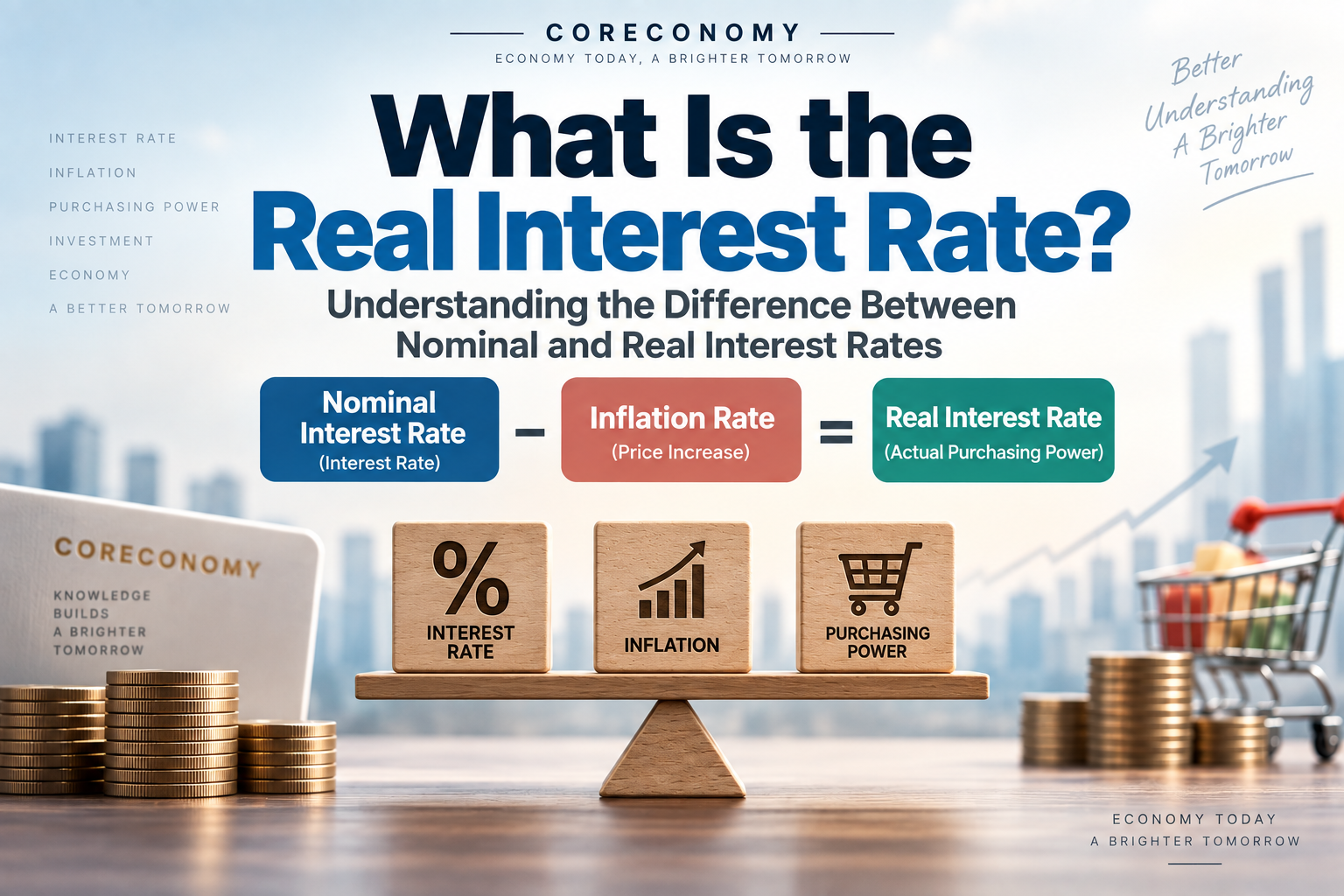
The real interest rate is the interest rate after taking inflation into account.
Simply put, it helps us understand how much the purchasing power of our money has actually changed.
A simple way to express it is:
Real interest rate ≈ Nominal interest rate − Inflation rate
For example:
- Nominal interest rate: 5%
- Inflation rate: 3%
Then:
Real interest rate ≈ 5% − 3% = 2%
In other words, the nominal interest rate is 5%, but after considering inflation, the increase in purchasing power is approximately 2%.
3. Why Do Nominal and Real Interest Rates Matter?
A 5% interest rate does not necessarily mean that the return is high in real terms.
It depends on how quickly prices are rising.
Consider two situations.
Situation A
- Nominal interest rate: 5%
- Inflation rate: 2%
→ Real interest rate: approximately 3%
Situation B
- Nominal interest rate: 5%
- Inflation rate: 6%
→ Real interest rate: approximately -1%
The nominal interest rate is 5% in both situations.
But the real interest rate is very different.
In Situation B, your account balance may increase because you are earning interest, but prices are rising even faster. As a result, your purchasing power may actually decline.
4. Can the Real Interest Rate Be Negative?
Yes. The real interest rate can fall below zero.
For example, suppose the nominal interest rate is 3% while inflation is 5%.
Then:
Real interest rate ≈ 3% − 5% = -2%
Your bank balance would still increase in nominal terms, but your purchasing power could decline after accounting for inflation.
This is why, during periods of high inflation, it is important to look beyond the nominal interest rate and consider the real interest rate as well.
5. Who Benefits From a Higher Real Interest Rate?
A higher real interest rate does not affect everyone in the same way.
The perspective is different for someone lending money and someone borrowing it.
Consider a saver first.
Suppose the nominal interest rate is 5% and inflation is 2%. The real interest rate is approximately 3%.
Because the interest earned is growing faster than prices, the purchasing power of the saver may increase.
Therefore, from the perspective of someone who lends money—such as a depositor or bond investor—a higher real interest rate can generally be more favorable.
The situation is different for a borrower.
If the borrowing rate is 5% and inflation is 2%, the real cost of borrowing is different from simply looking at the 5% nominal rate.
When the real interest rate is high, the real burden of borrowing can become greater.
In simple terms:
- Depositors and bond investors: A higher real interest rate can be relatively favorable.
- Borrowers: A higher real interest rate can be relatively unfavorable.
Because of this, real interest rates can influence household and business decisions about saving, borrowing, consumption, and investment.
6. Why Is the Real Interest Rate Important for Investors?
The real interest rate is also important when investors evaluate the return on an asset.
Suppose a financial product offers a 4% annual return.
If inflation is 1%, the return may represent a meaningful increase in purchasing power.
But if inflation is 5%, the nominal return is 4% while the real return may be negative.
Therefore, investors should consider more than simply asking:
“How much interest or return am I earning?”
It is also important to ask:
“How much of my purchasing power will remain after inflation?”
This is one reason why real interest rates are useful when evaluating investments.
7. How Are Real Interest Rates Related to Treasury Yields?
To understand this relationship, it helps to first think about what a Treasury yield represents.
Suppose the yield on a 10-year U.S. Treasury is 5%.
This is the market yield on a 10-year Treasury at that time. It represents the return investors demand for holding the bond at its current market price, under the assumption that the bond is held to maturity.
But investors have another question to consider:
“How much will prices rise over the period I hold this investment?”
If investors expect inflation to average around 3% over the long term, a 5% nominal yield does not represent a 5% increase in purchasing power.
As a simple way of thinking about it, subtracting expected inflation of 3% from a nominal yield of 5% leaves approximately 2%.
This illustrates the basic idea behind a real interest rate.
In other words, when looking at Treasury yields, it is useful to ask not only:
“How high is the Treasury yield?”
but also:
“How much of that yield remains after accounting for inflation?”
A rise in Treasury yields does not always mean the same thing
Suppose the 10-year U.S. Treasury yield rises from 4% to 5%.
There can be several reasons for this move.
One possibility is that inflation expectations are rising.
If investors expect prices to rise faster in the future, they may demand higher yields to compensate for the expected loss of purchasing power.
As investors sell existing bonds, bond prices can fall and Treasury yields can rise.
In this situation, the nominal yield may rise while the real interest rate rises by less.
Another possibility is that the real interest rate itself is rising.
If inflation expectations do not change significantly, but investors demand a higher real return, Treasury yields can still rise.
In that case, it would be difficult to explain the entire move simply by saying, “Inflation is rising.”
Expectations for economic growth, monetary policy, the supply and demand for Treasury securities, government borrowing, and the term premium—the additional compensation investors may require for holding longer-term bonds—can all affect long-term Treasury yields.
Therefore, when long-term Treasury yields move, it can be useful to look at both inflation expectations and real interest rates, rather than focusing only on the nominal yield.
8. Which Inflation Rate Should Be Used to Calculate the Real Interest Rate?
The calculated real interest rate can vary depending on which measure of inflation is used.
Two major inflation measures in the United States are the Consumer Price Index (CPI) and the Personal Consumption Expenditures (PCE) price index.
What Is CPI?
The Consumer Price Index (CPI) measures changes over time in the prices of goods and services typically purchased by consumers.
It is widely used to understand changes in consumer prices and the cost of everyday living.
What Is the PCE Price Index?
The Personal Consumption Expenditures (PCE) price index is another major measure of inflation in the United States.
It measures changes in the prices of goods and services purchased by consumers and is known for covering a broad range of consumer spending while reflecting changes in consumer behavior.
The PCE price index is also an important measure used by the Federal Reserve when assessing price stability.
For this reason, when discussing real interest rates in the United States, it is useful to know which inflation measure is being used and why.
However, you do not need to examine every inflation measure in detail just to understand the basic concept of a real interest rate.
For a simple explanation, you can think of the real interest rate as:
Nominal interest rate − Inflation rate
The important thing is not to memorize a particular number, but to understand the basic idea:
“After accounting for inflation, how much real return is left from the nominal interest rate?”
Conclusion
The real interest rate is a useful concept for understanding how interest rates affect purchasing power after taking inflation into account.
The key points are:
- Nominal interest rate: The stated interest rate before adjusting for inflation
- Real interest rate: The interest rate after accounting for inflation
- Real interest rate ≈ Nominal interest rate − Inflation rate
- The real interest rate can become negative when inflation is higher than the nominal interest rate
- A higher real interest rate can affect savers and borrowers differently
- Real interest rates are also important when understanding investments and Treasury markets
When looking at an interest rate, asking “What is the rate?” is only part of the picture.
It is also worth asking:
“What does that rate mean after considering inflation?”
Ultimately, the real interest rate helps us understand not just how much money grows in numerical terms, but how the purchasing power of that money changes over time.