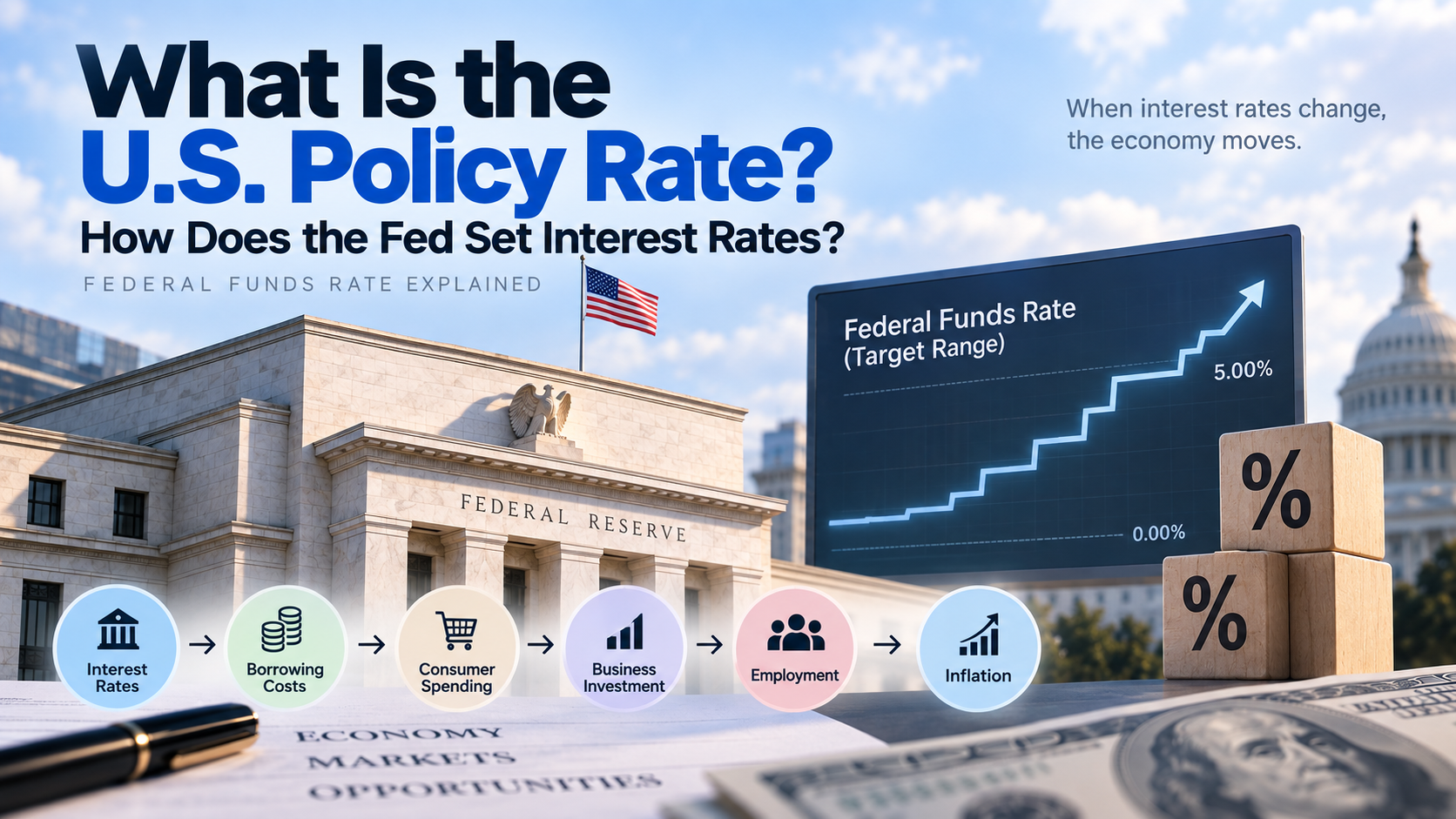
When you read financial news, you will often see headlines like:
“The Federal Reserve raised interest rates by 0.25 percentage points.”
“The Fed kept interest rates unchanged.”
“U.S. interest rates remain high.”
But what exactly is the U.S. interest rate that people are talking about?
Why does Google show something like:
4.00%–4.25%
instead of one number?
And if the Federal Reserve raises rates by 0.25 percentage points, does that mean your bank’s loan rate also rises by exactly 0.25 percentage points?
What about the 10-year Treasury yield? Is that the same thing?
For beginners, these terms can be confusing because several different interest rates appear to be connected.
They are connected—but they are not the same rate.
Let’s start with the most important one.
1. What Is the U.S. Policy Rate?
When people talk about the U.S. policy rate, they are generally referring to the target range for the federal funds rate.
So what is the federal funds rate?
In simple terms, it is:
The short-term market interest rate at which banks and other eligible financial institutions lend funds to one another, typically overnight.
This is a very short-term interest rate related to transactions between financial institutions. The Federal Reserve describes the federal funds rate as the rate at which depository institutions lend balances held at Federal Reserve Banks to other depository institutions, generally overnight.
But this definition immediately raises another question:
“What exactly are they lending to each other?”
To understand that, we need to briefly look at something called reserves.
2. What Are Bank Reserves?
Banks have more than the money we see in our checking and savings accounts.
As part of the banking system, financial institutions can hold reserve balances at Federal Reserve Banks.
For a beginner, it is easiest to think of reserves as:
A bank’s balance in its account at the Federal Reserve.
These balances are part of how the banking system handles payments and manages short-term liquidity.
Now imagine two banks.
Bank A
Bank A has more reserves than it currently needs.
Bank B
Bank B needs additional reserves for its short-term liquidity needs.
Bank A may lend reserves to Bank B overnight.
The interest rate applied to that transaction is the:
Federal Funds Rate
So the basic idea is:
Bank A → lends reserves to Bank B
Bank B → repays Bank A
Interest rate on the transaction → Federal Funds Rate
The important point is that this is not the interest rate you pay when you take out a mortgage or credit-card loan.
It is a very short-term rate used within the financial system.
3. Why Is the U.S. Policy Rate Shown as a Range?
This is one of the first things that can confuse people who are new to U.S. monetary policy.
Suppose you search for the U.S. policy rate and see:
4.00%–4.25%
Why are there two numbers?
Because the Federal Reserve does not simply choose one fixed number and directly force every overnight transaction to happen at that exact rate.
Instead, the Federal Open Market Committee (FOMC) sets a:
Target range
for the federal funds rate.
In simple terms, the Fed is saying:
“We want the federal funds rate to operate within this range, and we will use our monetary-policy tools to guide financial conditions accordingly.”
So if the target range is:
4.00%–4.25%
that does not mean:
“The Federal Reserve lends every bank money at 4.00% or 4.25%.”
It means the Fed has established a range within which it wants the federal funds rate to operate.
This distinction is important.
4. Does the FOMC Directly Set Every Overnight Interest Rate?
No.
The FOMC sets the target range.
The actual federal funds rate is formed through transactions between financial institutions.
A simplified example looks like this:
Bank A has extra reserves
↓
Bank B needs reserves
↓
Bank A lends to Bank B overnight
↓
A transaction takes place
↓
The market rate is formed
The Federal Reserve uses monetary-policy tools to influence financial conditions so that the federal funds rate operates within or close to the target range.
So you can think of it this way:
FOMC → sets the target range
Financial institutions → conduct the transactions
Market → produces the actual rate
This is much closer to what “the Fed sets interest rates” really means.
5. What Is the Difference Between the Fed and the FOMC?
You will often hear both terms in the news.
They are related, but they are not exactly the same thing.
The Fed
The Federal Reserve System, often called the Fed, is the central banking system of the United States.
The FOMC
The Federal Open Market Committee, or FOMC, is the committee responsible for making U.S. monetary-policy decisions.
So when a news report says:
“The Fed raised interest rates.”
the more precise description is:
“The FOMC raised the target range for the federal funds rate.”
Understanding this difference makes U.S. interest-rate news much easier to follow.
6. Why Does the Federal Funds Rate Matter to the Economy?
At first, the federal funds rate may sound like a problem only for banks.
You might reasonably ask:
“Why should I care about a rate on overnight borrowing between financial institutions?”
Because it is a key starting point for monetary policy.
Changes in the federal funds rate can influence broader financial conditions, including other short-term interest rates and the cost of borrowing across the economy.
A simplified chain looks like this:
Federal Funds Rate
↓
Financial-market conditions
↓
Borrowing costs for households and businesses
↓
Consumer spending and business investment
↓
Economic activity
↓
Employment and inflation
The actual process is more complicated than this, but the basic idea is important:
A very short-term interest rate can influence decisions throughout the economy.
7. If the Fed Raises Rates by 0.25 Percentage Points, Do Bank Loan Rates Also Rise by 0.25 Percentage Points?
Not necessarily.
Suppose the FOMC raises the target range from:
4.00%–4.25%
to:
4.25%–4.50%
The target range has increased by:
0.25 percentage points
But this does not mean every bank loan automatically becomes 0.25 percentage points more expensive.
A bank considers many factors when setting lending rates.
These can include:
- Its own funding costs
- The borrower’s credit risk
- The type of loan
- Market competition
- Operating costs
- Capital costs
- The bank’s profit margin
So, for example, a loan rate of:
6.00%
might rise to:
6.25%
But it could also rise by more or less than that.
The key idea is:
The policy rate is not a direct copy of every bank lending rate.
It is an important influence on the financial environment in which banks operate.
8. What Happens When the Fed Cuts Rates?
The same principle works in the other direction.
Suppose the target range falls from:
4.00%–4.25%
to:
3.75%–4.00%
That is a 0.25 percentage-point cut.
But a bank does not have to reduce every lending rate by exactly 0.25 percentage points.
A loan rate could move:
6.00% → 5.75%
or:
6.00% → 5.50%
or:
6.00% → 5.90%
depending on funding costs, competition, credit risk, and other conditions.
Banks are businesses, so profitability matters.
But it would be too simplistic to say:
“A bank can never lower its loan rate by more than the policy rate.”
There is no universal one-to-one formula.
The better way to think about it is:
Policy rates influence bank lending rates, but they do not mechanically determine them.
9. Why Does the Fed Raise Interest Rates?
One of the main reasons is to help control inflation.
But there is an important point that beginners often miss:
The Fed does not raise rates only when the economy is weak.
Sometimes it raises rates because the economy is very strong.
That may sound strange at first.
Why would a strong economy be a problem?
10. How Can a Strong Economy Lead to Higher Interest Rates?
Imagine that the economy is growing strongly.
People have jobs and incomes are rising.
As a result:
Consumer spending ↑
Businesses may respond by:
Investment ↑
Employment may also rise.
All of this can be positive.
But imagine demand becomes extremely strong while the supply of goods and services cannot increase quickly enough.
For example:
People want to buy more cars
while:
Car production cannot increase fast enough
Then businesses may find that they can raise prices.
At the broader economic level, this can create:
Strong demand
↓
Greater pricing pressure
↓
Higher inflation pressure
To learn more about inflation and how rising prices affect the economy, see Understanding Inflation, Deflation, and Stagflation.
If this continues for too long, inflation can become more persistent.
The economy may then be described as:
Overheating
11. So the Fed May Raise Rates to Cool the Economy
If the Fed believes the economy is overheating and inflation is likely to remain too high for too long, it may use tighter monetary policy.
One of the main tools is:
Raising the target range for the federal funds rate
A simplified chain looks like this:
Interest rates ↑
↓
Borrowing becomes more expensive
↓
Some households and businesses reduce spending or investment
↓
Economic demand slows
↓
Inflation pressure may ease
So:
Higher interest rates do not always mean the economy is doing badly.
Sometimes they mean the economy is strong enough that the Fed is trying to prevent inflation from becoming too persistent.
12. Does a Strong Economy Always Mean Higher Rates?
No.
This distinction is important.
A strong economy with:
Strong growth
+
Better productivity
+
Stable inflation
does not automatically require higher interest rates.
The situation becomes more concerning when:
Strong economic activity + excessive demand + persistent inflation pressure
appear together.
So the better rule is:
Strong economy → not necessarily higher rates
but:
Overheating economy with persistent inflation pressure → greater chance of higher rates
This is a much better way to understand the Fed’s decisions.
13. Why Does the Fed Cut Interest Rates?
Now consider the opposite situation.
Suppose the economy is weakening.
You may see:
Consumer spending ↓
Business investment ↓
Employment ↓
If inflation pressure is also falling, the Fed may lower interest rates to make financial conditions more supportive.
A simplified chain is:
Interest rates ↓
↓
Borrowing costs ↓
↓
Spending and investment become easier
↓
Economic activity receives support
But there is an important warning:
A rate cut does not automatically mean the economy is healthy.
Sometimes the Fed cuts rates because the economy is weakening.
So when you hear:
“The Fed cut rates.”
don’t immediately think:
“The economy must be getting better.”
A more useful question is:
“Why did the Fed cut rates?”
14. What Does the Fed Look At When It Sets Policy?
The Fed does not simply look at one economic number and follow a fixed rule.
The FOMC considers a wide range of economic and financial information.
Some of the most important areas include:
Inflation
How high is inflation?
Is it moving up or down?
Is inflation likely to remain elevated?
Employment
Is the labor market strong?
Is it becoming too tight?
Or is the labor market weakening?
Economic Activity
How strong are consumer spending, business investment, and overall economic activity?
Financial Conditions
What is happening in financial markets and credit markets?
The Outlook
The Fed also considers what may happen next.
It is not only asking:
“What is happening today?”
It is also asking:
“Where is the economy likely to go from here?”
This matters because monetary policy affects the economy with a time lag.
15. What Is the Difference Between the Federal Funds Rate and the “U.S. Policy Rate”?
Now let’s return to one of the most confusing terms.
In the United States, you generally do not need to think of the federal funds rate and the U.S. policy rate as two completely separate rates.
A useful distinction is:
Federal Funds Rate
The actual short-term market rate formed through transactions among eligible financial institutions.
Federal Funds Rate Target Range
The range set by the FOMC for where the federal funds rate is intended to operate.
U.S. Policy Rate
A common term used to refer to the Federal Reserve’s key policy rate—in practice, the target range for the federal funds rate.
So when a news report says:
“The U.S. central bank raised its policy rate by 0.25 percentage points.”
it generally means:
“The FOMC raised the target range for the federal funds rate by 0.25 percentage points.”
That is what people usually mean when they talk about the U.S. “policy rate.”
16. How Is This Different From the 10-Year Treasury Yield?
Now we can connect this article to the previous one.
The U.S. policy rate and the 10-year Treasury yield are not the same thing.
U.S. Policy Rate
The target range for the federal funds rate.
It is a key tool of Federal Reserve monetary policy.
10-Year Treasury Yield
The market yield on a 10-year U.S. Treasury security.
It is determined in the Treasury market.
The two are connected, but they do not move in a fixed one-to-one relationship.
For example:
The Fed raises its policy rate by 0.25 percentage points
does not automatically mean:
The 10-year Treasury yield rises by 0.25 percentage points.
The 10-year yield reflects market expectations about:
- Future interest rates
- Inflation
- Economic growth
- Treasury supply and demand
- Term premium
- Longer-term uncertainty
This is why the Fed can raise short-term policy rates while the 10-year Treasury yield moves by a different amount—or even in the opposite direction.
To understand how interest rates and bond prices are connected, see Understanding Interest Rates and Bonds.
17. Why Can Interest Rates Affect Stock Prices?
The federal funds rate is a very short-term rate, but changes in monetary policy can affect financial markets more broadly.
When interest rates rise:
Borrowing costs may increase
and:
Future cash flows can become less valuable when discounted at a higher rate.
This can put pressure on stock valuations.
But:
Higher interest rates do not automatically mean lower stock prices.
Suppose rates are rising because the economy is very strong and corporate earnings are improving.
Stronger earnings can offset some of the pressure caused by higher interest rates.
So once again, the important question is:
“Why are interest rates moving?”
18. How Is the Policy Rate Different From Quantitative Easing?
We have already discussed Quantitative Easing (QE) in another article.
The two policies are related, but they are not the same.
Policy Rate
The Federal Reserve changes the target range for the federal funds rate.
Quantitative Easing
The central bank buys large amounts of financial assets, such as Treasury securities or mortgage-backed securities, in an effort to ease financial conditions.
A simple way to remember the difference is:
Policy rate → changes the central bank’s key short-term interest-rate target
QE → uses large-scale asset purchases to influence financial conditions
QE is therefore a different policy tool from simply changing the federal funds rate target.
To learn more about how quantitative easing works, see Understanding Quantitative Easing (QE).
19. Five Terms You Should Remember
You do not need to memorize every detail.
Just remember these five terms.
| Term | Simple meaning |
|---|---|
| Fed | The U.S. central banking system |
| FOMC | The committee that makes U.S. monetary-policy decisions |
| Federal Funds Rate | A short-term market rate for overnight lending between eligible financial institutions |
| Federal Funds Rate Target Range | The range set by the FOMC for the federal funds rate |
| 10-Year Treasury Yield | The market yield on a 10-year U.S. Treasury security |
And when someone says:
“The U.S. policy rate”
they are generally referring to:
the target range for the federal funds rate.
20. Put It All Together
Now let’s connect everything.
The FOMC makes a monetary-policy decision
↓
The FOMC sets the target range for the federal funds rate
↓
The federal funds rate forms through short-term financial-market transactions
↓
The Fed influences financial conditions so the market rate stays near the target range
↓
Other short-term rates and borrowing conditions are affected
↓
Households and businesses may change spending and investment
↓
Economic activity, employment, and inflation can change
At the same time:
The 10-year Treasury yield
is determined separately in the bond market and reflects expectations about:
Future rates + Inflation + Growth + Treasury supply and demand + Term premium
That is why the U.S. policy rate and the 10-year Treasury yield are connected—but not identical.
Government debt and interest costs are another important part of this picture. To see how governments can manage high debt, see Government Debt Explained: How Governments Manage High Debt.
Conclusion
U.S. interest rates can seem confusing because several different terms appear in the same news story:
Fed
FOMC
Federal Funds Rate
Target Range
Bank Lending Rates
10-Year Treasury Yield
But each one has a different role.
The simplest way to remember the system is:
The FOMC sets a target range for the federal funds rate.
The actual federal funds rate is formed in the financial market.
The Federal Reserve influences financial conditions so the market rate operates near the target range.
Those changes can affect borrowing costs, spending, investment, employment, and inflation.
And perhaps the most important distinction is this:
The U.S. policy rate and the 10-year Treasury yield are not the same interest rate.
The policy rate is the key short-term rate used by the Federal Reserve in monetary policy.
The 10-year Treasury yield is a market-determined long-term interest rate that reflects how investors view the future economy, inflation, interest rates, government borrowing, and long-term risk.
So the next time you read:
“The Fed raised rates.”
don’t simply think:
“All interest rates went up.”
Instead, ask:
“Why did the Fed raise rates, and how will that change spread through the economy?”
And when you see:
“The 10-year Treasury yield rose.”
ask:
“What is the bond market expecting about future rates, inflation, growth, and government debt?”
Once you start making those distinctions, U.S. monetary policy becomes much easier to understand.