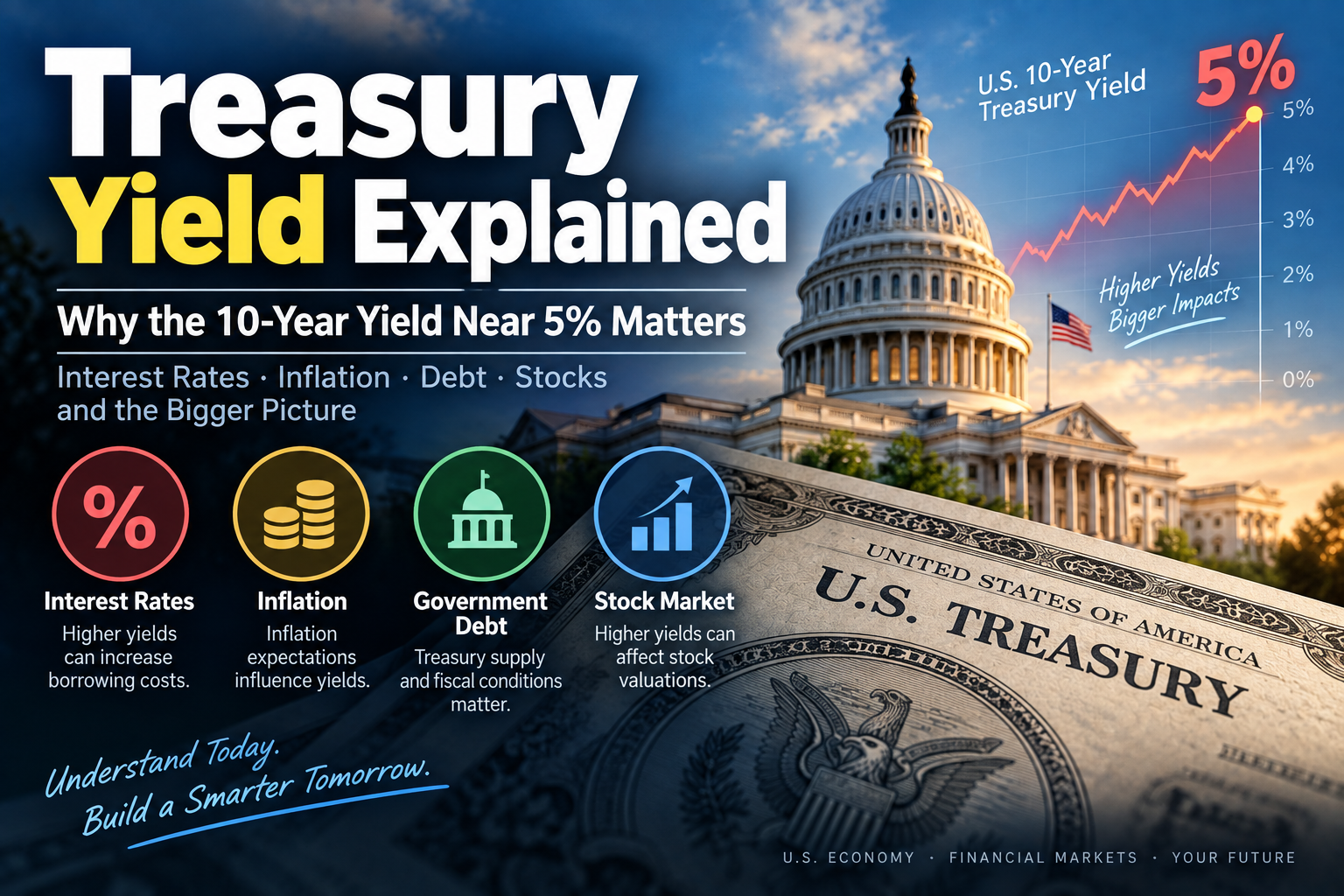
Economic news often says things like:
“The U.S. 10-year Treasury yield is approaching 5%.”
“Rising Treasury yields are putting pressure on stocks.”
“Higher long-term rates are increasing borrowing costs for households and businesses.”
But if you are new to economics, you may wonder:
“Why does the interest rate on U.S. government debt affect my stocks?”
“Why is 5% such an important number?”
“If Treasury yields rise, why do bond prices fall?”
“Does the Federal Reserve directly control the 10-year Treasury yield?”
These are all good questions.
Let’s start with the current situation.
The U.S. 10-year Treasury yield was 4.96% on September 11, 2026, according to the U.S. Treasury’s daily yield data. Reuters reported that the yield had recently climbed to around 4.98% intraday, bringing it very close to the widely watched 5% level.
Source: U.S. Department of the Treasury — Daily Treasury Par Yield Curve Rates
Does that mean:
“A 5% 10-year Treasury yield = financial crisis”?
Not necessarily.
The 5% level can be an important psychological threshold for investors, but it is not a fixed economic danger line.
The more useful question is:
Why is the 10-year Treasury yield approaching 5%?
Let’s break it down step by step.
1. What Is a U.S. Treasury Bond?
A government bond is simply:
A way for the government to borrow money from investors.
The U.S. government spends money on things such as:
- Public programs
- Defense
- Infrastructure
- Government operations
- Interest payments on existing debt
When tax revenue is not enough to cover spending, the government can borrow money by issuing Treasury securities.
In return, investors receive:
Interest payments + repayment of principal
according to the terms of the security.
U.S. Treasury securities come in several forms depending on maturity.
Treasury Bills
Short-term securities with maturities of one year or less.
Treasury Notes
Securities with maturities generally ranging from two to ten years.
Treasury Bonds
Longer-term securities, including 20-year and 30-year maturities.
The 10-year Treasury is therefore a Treasury Note.
2. What Exactly Is the “10-Year Treasury Yield”?
This is where beginners often get confused.
The 10-year Treasury yield is not simply a fixed interest rate that the U.S. government chooses for every 10-year bond.
The yield reported in financial markets is based on the market price and cash flows of Treasury securities.
The basic relationship is:
Bond price ↑ → Yield ↓
and:
Bond price ↓ → Yield ↑
Imagine a bond that promises a certain stream of future payments.
If investors are willing to pay less for that bond in the market, a new buyer is getting the same future payments for a lower price.
That means the buyer’s yield becomes higher.
So:
When the price of an existing Treasury bond falls, its yield rises.
This leads to an important point:
“The 10-year Treasury yield is 5%” does not mean every 10-year Treasury bond pays a 5% coupon. It means the market yield calculated from current prices and cash flows is around 5%.
This is the same basic relationship between bond prices and yields we discussed in Understanding Interest Rates and Bonds.
3. Why Is the 10-Year Treasury Yield So Important?
The 10-year Treasury yield is much more than a number showing how much the U.S. government pays to borrow.
Because the U.S. Treasury market is one of the most important financial markets in the world, its long-term yields reflect many things at once.
They include:
- Expectations for future interest rates
- Inflation expectations
- Economic growth expectations
- Government borrowing needs
- Investor demand for Treasuries
- Risk and uncertainty
- The discount rates used to value financial assets
This is why investors around the world watch the 10-year Treasury yield.
It provides an important reference point for long-term financial conditions.
4. Does the Federal Reserve Directly Set the 10-Year Treasury Yield?
No.
This is an important distinction.
The Federal Reserve uses the federal funds rate target range as a key monetary-policy tool.
The 10-year Treasury yield, however, is determined in the Treasury market by buying and selling among investors.
The Federal Reserve can strongly influence the 10-year yield.
For example, if investors believe:
“The Fed will keep interest rates high for longer.”
longer-term yields may come under upward pressure.
But the 10-year yield does not depend only on today’s Fed policy rate.
It also reflects expectations about:
Future interest rates + Inflation + Economic growth + Risk + Treasury supply and demand
That is why the 10-year yield can move even when the Fed has not changed its policy rate.
5. What Makes the 10-Year Treasury Yield Move?
As a beginner, five ideas are enough to get started.
① Expectations for Future Interest Rates
Markets constantly ask:
“What will the Federal Reserve do next?”
If investors expect interest rates to remain high for a long time, longer-term Treasury yields can come under upward pressure.
But expectations can change quickly as new economic data arrives.
② Inflation Expectations
Imagine you lend money for ten years.
If you expect prices to rise rapidly over those ten years, you may worry that the money you receive in the future will have less purchasing power.
You may therefore demand a higher yield.
In simple terms:
Higher expected inflation can push longer-term yields higher.
To understand what inflation actually means and how it affects purchasing power, see Inflation, Deflation, and Stagflation Explained.
③ Economic Growth Expectations
Suppose investors expect strong economic growth.
That can mean:
Business investment ↑
Consumer spending ↑
Demand for capital ↑
This can contribute to higher long-term interest rates.
On the other hand, if investors expect a severe recession, long-term yields may come under downward pressure.
But a recession does not always mean lower 10-year yields.
If inflation concerns or fiscal concerns remain strong, long-term yields can stay elevated even when economic growth weakens.
④ Treasury Supply and Demand
The U.S. government finances budget deficits partly by issuing Treasury securities.
If the government issues a large amount of debt, the supply of Treasuries increases.
But:
More Treasury supply does not automatically mean higher yields.
You also have to look at demand.
If investors are willing to absorb the additional supply, the effect on yields may be limited.
If supply increases while demand becomes weaker, Treasury prices can come under pressure and yields can rise.
⑤ Term Premium
This term sounds complicated, but the idea is fairly simple.
Holding a bond for ten years involves uncertainty about:
- Inflation
- Interest rates
- Economic conditions
- Treasury supply
- Future market conditions
The term premium can be thought of as the additional compensation investors may require for holding a longer-term bond while facing those uncertainties.
It is not simply compensation for default risk. U.S. Treasuries are influenced much more by changes in interest rates, inflation, and market conditions.
6. Why Is 5% Such a Big Number?
First, remember:
5% is not an official economic danger line.
If the 10-year Treasury yield moves from:
4.9% → 5.0%
the financial system does not suddenly enter a completely different state.
So why does the market care?
Because round numbers can become psychological reference points.
There is another reason.
If investors can earn around:
5% nominal yield
from a long-term U.S. Treasury, other assets may need to offer enough potential return to remain attractive relative to that relatively lower-risk alternative.
This does not mean investors automatically sell stocks and buy Treasuries.
It means the relative attractiveness of different assets can change.
So the more important question is not:
“Did the yield cross 5%?”
but:
“Why is the yield approaching 5%?”
7. Does a 5% Treasury Yield Mean Everyone Will Move Their Money Into Treasuries?
No.
Treasuries, corporate bonds, and stocks all have different levels of risk and different potential returns.
Imagine an investor comparing:
U.S. 10-year Treasury yield: 5%
with:
Expected return from a company’s stock
The investor is not simply comparing two numbers.
Stocks involve:
- Potential earnings growth
- Dividends
- Share-price appreciation
- Business risk
- Potential losses
A Treasury has a different risk and return profile.
So a higher 10-year yield does not mean:
“All money will leave stocks and move into Treasuries.”
A better way to think about it is:
When relatively low-risk Treasury yields rise, other assets may need to offer higher expected returns to remain attractive.
This can affect how investors value stocks, bonds, and other financial assets.
8. How Can a Higher 10-Year Yield Affect Stocks?
This is where the idea of a discount rate becomes useful.
A stock represents a claim on future cash flows.
Imagine a company is expected to generate:
$1,000
ten years from now.
That future money has to be converted into today’s value.
If the discount rate rises, the present value of that future money falls.
This is one reason rising long-term yields can put pressure on stock valuations.
The effect can be especially noticeable for companies whose expected profits are:
Far in the future
Growth-oriented companies are often more sensitive to changes in discount rates for this reason.
But:
Higher 10-year yields do not automatically mean falling stock prices.
If higher yields are happening because economic growth and corporate earnings expectations are improving, stronger earnings can offset some of the pressure from higher discount rates.
9. How Are Mortgages and Corporate Loans Connected to the 10-Year Yield?
The 10-year Treasury yield is an important reference point for many long-term financial products.
For example, U.S. fixed-rate mortgage rates are influenced by long-term Treasury yields, but:
Mortgage rates do not simply equal the 10-year Treasury yield.
Mortgage rates also depend on:
- Mortgage-backed securities markets
- Financial institutions’ funding costs
- Credit risk
- Market liquidity
- Investor demand
Corporate bond yields can be thought of in a similarly simple way:
Treasury yield + Credit spread
The credit spread reflects the additional compensation investors may demand for taking the risk of lending to a company instead of the U.S. government.
So when the 10-year Treasury yield rises, corporate borrowing costs can rise too.
But:
“The 10-year Treasury yield rises by 1%, so every loan rate rises by exactly 1%.”
is not how the financial system works.
10. Why Do Investors Watch the Yield Curve?
Now let’s move one step deeper.
A common measure is:
10-year Treasury yield − 2-year Treasury yield
This is often used to describe part of the yield curve.
For example:
10-year yield = 4.5%
2-year yield = 4.8%
Then:
10-year − 2-year = -0.3 percentage points
This means the shorter-term yield is higher than the longer-term yield.
That situation is commonly called:
Yield-curve inversion
Yield-curve inversions have historically appeared before many U.S. recessions, which is why investors pay attention to them.
But:
Inversion does not guarantee a recession.
And:
A later steepening or “un-inversion” does not automatically mean a recovery is beginning.
The yield curve reflects many factors, including:
- Monetary policy
- Economic expectations
- Inflation expectations
- Term premium
- Treasury supply and demand
So it is a useful indicator—not a crystal ball.
11. Why Does the Real Interest Rate Matter?
Suppose the 10-year Treasury yield is:
5%
That number alone does not tell the whole story.
You also need to think about inflation.
A simple way for beginners to understand the real interest rate is:
Real interest rate ≈ Nominal interest rate − Expected inflation
For example:
Nominal yield = 5%
Expected inflation = 3%
Then, as a simple approximation:
Real interest rate ≈ 2%
The U.S. Treasury also publishes separate real yields based on Treasury Inflation-Protected Securities, or TIPS. On September 11, 2026, the 10-year real Treasury yield was 2.60%.
Source: U.S. Department of the Treasury — Daily Treasury Par Real Yield Curve Rates
Why does this matter?
Because investors and businesses care not only about the number of dollars they receive, but also about:
What those dollars will be able to buy.
Higher real interest rates can put additional pressure on businesses and assets that depend heavily on future cash flows.
Lower real rates can make some riskier assets relatively more attractive.
But again:
Real interest rates are one important variable, not a complete explanation for every market move.
12. Does Quantitative Tightening Mean the Fed Is Dumping Treasuries Into the Market?
Not necessarily.
Quantitative tightening, or QT, is often simplified as:
“The Fed is selling its Treasury bonds.”
That is too simplistic.
One important way the Federal Reserve reduces the size of its balance sheet is by allowing securities to mature without fully reinvesting the proceeds.
So a beginner can think of it this way:
QE → Fed balance sheet expands
QT → Fed balance sheet contracts
QT can affect financial conditions and liquidity.
To understand how quantitative easing works and how it affects financial conditions, see Understanding Quantitative Easing (QE).
But:
QT does not simply mean the Fed is flooding the market with large amounts of Treasury securities through outright sales.
The mechanics matter.
13. What Is the TGA?
TGA stands for:
Treasury General Account
It is the U.S. Treasury’s main cash account held at the Federal Reserve.
A simple way to think about it is:
The U.S. government’s main cash account at the central bank.
As the government collects taxes and issues debt, money flows through the Treasury’s accounts.
When the government spends money, funds move back into the financial system.
That is why market participants sometimes watch:
Treasury issuance + TGA + bank reserves
when analyzing financial-market liquidity.
But one point is important:
The TGA does not determine the 10-year Treasury yield by itself.
It is simply one variable that can help explain changes in liquidity and financial conditions.
14. Why Is the 10-Year Treasury Yield Near 5% in 2026?
Several factors are interacting at the same time.
Current market discussion has focused particularly on:
Inflation concerns
Energy prices and geopolitical uncertainty
Large fiscal deficits and Treasury issuance
To understand how governments can manage a large debt burden, see Government Debt Explained: How Governments Manage High Debt.
Higher term premiums
On September 11, 2026, Reuters reported that the U.S. 10-year Treasury yield had fallen to around 4.93% after reaching an intraday high of 4.979%, as investors reacted to inflation concerns linked to higher oil prices and changing expectations for U.S. interest rates. Reuters also noted concerns related to large fiscal deficits and heavy government and corporate bond issuance.
Source: Reuters — U.S. 10-year borrowing costs pull back from 5%
The same report said August U.S. consumer prices were 3.4% higher than a year earlier.
So it would be too simplistic to say:
“The U.S. economy is collapsing, so Treasury yields are rising.”
A better way to think about the current environment is:
Inflation + Fiscal conditions + Treasury supply + Growth expectations + Monetary-policy expectations
are all interacting.
15. Does a 10-Year Treasury Yield Above 5% Mean a Financial Crisis Is Coming?
No.
This is one of the most important conclusions of this article.
Suppose the 10-year yield moves from:
4.96% → 5.01%
That does not mean the financial system suddenly becomes unstable.
The more important questions are:
How quickly did the yield rise?
Why did it rise?
Are inflation expectations rising?
How strong is economic growth?
Is Treasury demand still healthy?
Can financial institutions handle the higher rates?
For example:
Strong economic growth + improving productivity + moderate inflation
could push long-term yields higher for very different reasons than:
Rapidly rising inflation expectations + fiscal concerns + deteriorating market liquidity
So the same 5% yield can mean very different things depending on why it is happening.
16. What Other Indicators Should Investors Watch?
Instead of watching the 10-year yield by itself, investors often look at several related indicators.
① The 2-year Treasury yield
This can provide information about expectations for near-term Federal Reserve policy.
② The 10-year real yield
This helps show long-term financial conditions after accounting for inflation.
③ Inflation expectations
These provide clues about how markets view future price growth.
④ The yield curve
The relationship between short- and long-term yields can provide information about monetary policy and economic expectations.
⑤ Treasury supply and demand
Investors also watch how much debt the U.S. government is issuing and how strongly the market is absorbing that supply.
17. Connecting This to What We Have Already Learned
Now we can connect the ideas from Articles 8 through 10.
→ can increase purchasing power.
Government debt
→ allows governments to finance spending over time.
Debt management
→ forces governments to balance growth, fiscal policy, interest costs, and inflation.
And now:
The 10-year Treasury yield
→ shows how many of these forces are being reflected in market prices.
The broader chain looks like this:
Credit Expansion
↓
Private and Government Debt
↓
Inflation + Growth + Fiscal Conditions
↓
Interest-Rate and Monetary-Policy Expectations
↓
10-Year Treasury Yield
↓
Bonds + Stocks + Corporate Debt + Mortgages
Once you see this chain, a sentence like:
“The U.S. 10-year Treasury yield rose today.”
becomes a much more interesting question:
“Why did it rise?”
Conclusion
A 5% U.S. 10-year Treasury yield is not a magical number that automatically triggers an economic crisis.
But a sustained rise in long-term Treasury yields can matter greatly to financial markets.
Why?
Because long-term yields reflect a combination of:
Monetary-policy expectations
Inflation
Economic growth
Government borrowing and Treasury supply
Investor demand and risk perception
So when the 10-year yield rises, don’t stop at:
“The yield went above 5%.”
Instead, ask:
Why did it rise?
Is inflation the main reason?
Are government borrowing needs putting upward pressure on yields?
Are investors expecting interest rates to remain high?
Is economic growth unusually strong?
Or are investors demanding more compensation for long-term uncertainty?
As of September 2026, the U.S. 10-year Treasury yield has moved very close to 5%, but the level itself is less informative than the reason for the move, the speed of the move, and what other financial indicators are doing at the same time.
The most important thing to remember is this:
The 10-year Treasury yield is not simply “the interest rate on U.S. government debt.” It is a market price that reflects how investors are assessing future inflation, interest rates, economic growth, fiscal conditions, and long-term uncertainty.
From now on, when you see the U.S. 10-year Treasury yield move up or down, ask yourself:
“What is the market trying to tell us?”
That single question can change the way you read economic and financial news.